
On This Page
Introduction
Does carbonic acid for pH control add bicarbonates to water? Recently, some farmers have expressed serious concern about this possibility.
As a farmer, it is necessary to understand what you are applying, how it works together with the whole system, and to make the right decision for short and long-term crop health. We’re talking about the best berries in the world, grown in the best growing area of the United States. The stakes are high to get this right.
Carbonic acid is an acid and will lower the pH of water, decrease the bicarbonates, and help solubilize the nutrients the plant needs. But carbonic acid does not function the same as sulfuric acid. It does the same job, but in a different way.
We are water people at ECO2MIX. We have treated farms with carbonic acid for over nine years, and before that, worked with sulfuric acid and irrigation design. We are confident in what we do to support farmers. So we will walk through the questions raised and the chemistry as best we can. We will include sources so you can verify for yourself.
What the Technology Actually Is
To start, what are we doing when we say “carbonic acid water pH control with ECO2MIX?” It helps to understand what the system actually does, because the details of the equipment and how it operates impact the chemistry.
Irrigation systems are pressurized
When carbonic acid is injected into the mainline, it mixes with the water and maintains the water pH through the line. This is because it is a pressurized system. We have seen some pH rise in long-distance pipe runs, but it is minimal, and we check the pH at the end of the line outside of the dripper when we calibrate. It is a fairly stable system.
Most often, a higher measured pH at the end of the line is because it is being measured after the irrigation event, or with a pH probe that has not been calibrated. It is best to measure the water pH in a cup at the furthest dripper during irrigation.
pH-Probe driven injection
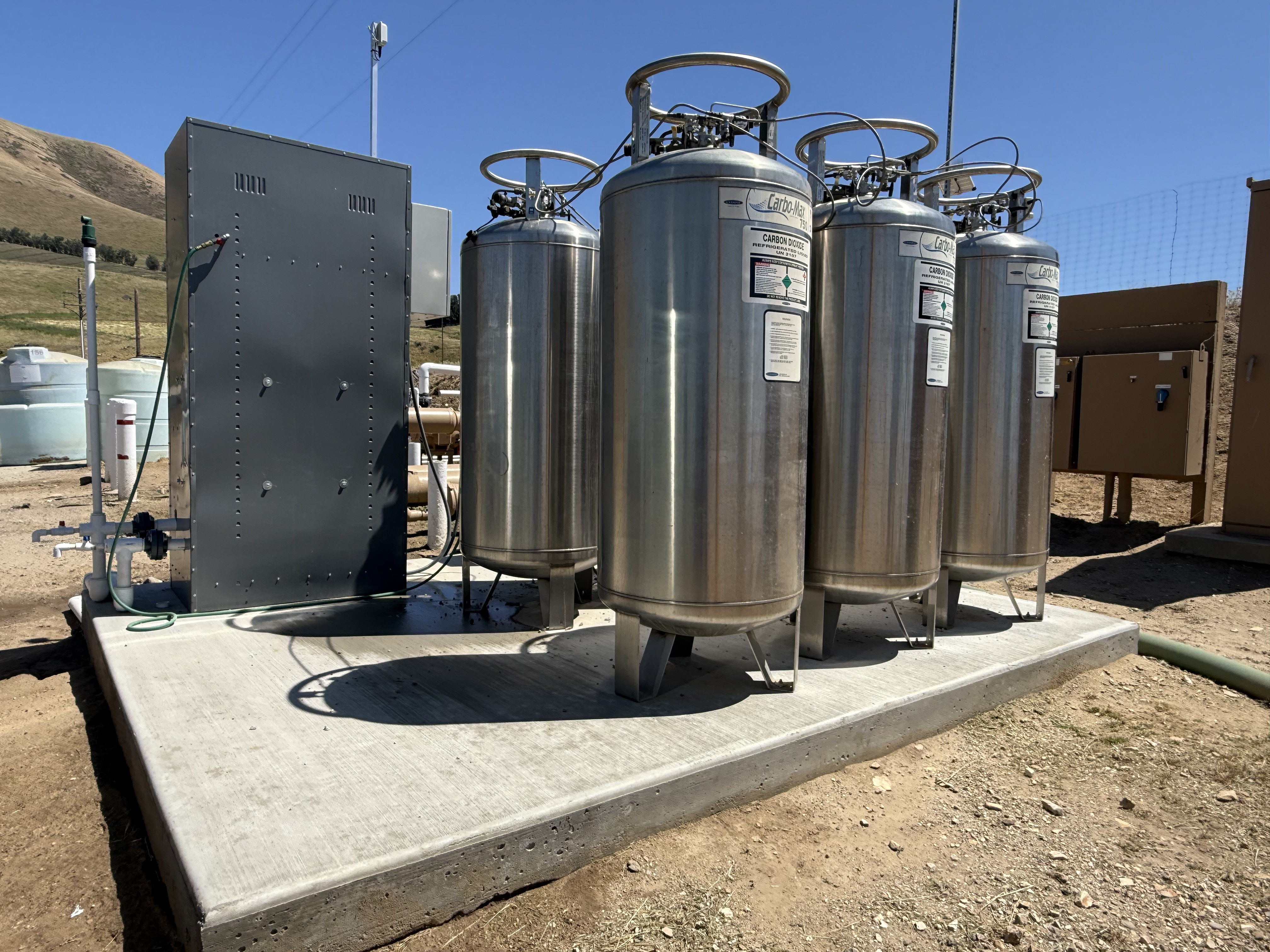
The ECO2MIX equipment works with a feedback loop, so the pH that is going to the field is always measured. A sample of water is taken by the equipment just before the pipe goes underground, the pH is tested, and then the amount of CO₂ dissolved in the water is adjusted.
Basically, if the target is 6.7 pH, the equipment will dissolve the CO₂ necessary to reach 6.7 pH. If the water quality changes, the injection will fine-tune automatically.
The claim that “it doesn’t really bring water much below 7.0 pH” could be true for unpressurized open systems, like a pool, but that is not a limit we have seen. We hold 6.5–6.7 pH for our customers, and have some farms that are running at 6.2 pH and 5.8 pH every time they irrigate.
This is not carbonating water (Which changes pH but wastes CO₂). We efficiently dissolve the CO₂ with our ECO2MIX reactor (efficiency = less wasted gas), creating carbonic acid, and then inject the carbonic acid into the mainline. This brings the cost down and allows for more precise control.
The 150 ppm CaCO₃ treatment limit cited from PWTAG, a pool water advisory group, was written for open swimming pool systems with different equipment. We have not seen that limit apply to agriculture, and regularly treat water that is much worse (300 ppm+). PWTAG actually suggests carbonic acid is the best option for pH control, and only cautions against using CO₂ indoors, which could cause asphyxiation from CO₂ buildup. That hazard is not a concern in outdoor agriculture.
Many of our research sources used carbonated water in their trials. The goal of these trials is water pH control, but their methods of dissolving the CO₂ in the water differ from ours. We use a small fraction of the CO₂ they use, and get the same pH control. Results should be comparable, and if there were negative effects from using carbonic acid from ECO2MIX, they would be compounded in these carbonated trials because they use more CO₂.
Raising Alkalinity
Does carbonic acid lower pH but raise alkalinity?
No, carbonic acid does not raise alkalinity. Yes, carbonic acid does lower pH.
Let’s look at the chemistry to form carbonic acid:
CO₂(aq) + H₂O ⇌ H₂CO₃(aq)
Part of that dissociates and creates a bicarbonate and hydrogen:
H₂CO₃(aq) ⇌ HCO₃⁻ + H⁺
Then the reaction can continue, it all exists in equilibrium based on pH and temperature. So by adding carbonic acid and lowering the pH, it splits and looks two different ways dependent on the pH. This is the formula:
HCO₃⁻ + H⁺ ⇌ H₂CO₃ ⇌ CO₂(aq) + H₂O
This formula does not mean carbonic is raising alkalinity or increases bicarbonates in the water, even though part of the carbonic acid creates a “new” bicarbonate (see Speciation).
Alkalinity is measured as acid-neutralizing capacity, and the HCO₃⁻ and H⁺ cancel each other out in the alkalinity equation.
Alkalinity = [2(CO₃²⁻)] + [OH⁻] + [HCO₃⁻] - [H⁺]
Though alkalinity doesn’t change, the pH still goes down because of the H⁺.
Changes in the concentration of dissolved CO₂ do not change alkalinity. Verspagen et al. (2014) Eqn (6).
A recent agriculture study using carbonated water confirms this. In medium and highly calcareous soils, there was no significant change in carbonates compared to the control. With the solubilization of Ca and Mg from carbonates, there was no additional bicarbonates created. They were using 400 ppm of CO₂, far more than we use in our processes. We estimate our average CO₂ range is from 50 to 100 ppm.
Speciation
The species of carbon in the water is pH dependent, which is why we know that H₂CO₃(aq) ⇌ HCO₃⁻ + H⁺ is only part of what is present in the treated water.
For example, at 8.0 pH, nearly all carbon is bicarbonate (~98%), and at 6.7 pH the treated water is 31% carbonic acid and 69% bicarbonate. So part of the carbonic acid added does create a “new” bicarbonate, and the total amount of bicarbonates in the water is reduced by the treatment. You will find the exact same ratio of bicarbonates and carbonic acid in the water when you lower the pH with sulfuric acid.
Lowering the pH actually converts some of the existing bicarbonate into carbonic acid, which is the opposite of the original claim. Adding CO₂, or carbonic acid, to the water does not increase the alkalinity or increase the bicarbonates. Alkalinity stays the same, and bicarbonates are reduced.
So what does CO2 actually change?
The wetting front and soil solution pH is changed with carbonic acid. Because water is constantly being applied during irrigation, and all of the water is treated, the soil solution stays at the optimal level for the plant.
CO₂ and water can break apart carbonates, like lime:
CaCO₃ + CO₂ + H₂O ⇌ Ca²⁺ + 2HCO₃⁻
making the Ca²⁺ and other cations soluble for the plant.
The principle behind carbonic acid for water pH control is a focus on the soil solution. That is the area and the time when the plant is taking nutrients and when the soil is active. Soil solution pH is the priority.
Why CO2 is Different from Mineral Acids
Water pH control and alkalinity reduction are not the same goal. The goal we are focused on is lowering the water pH. This section dives more into the differences between how sulfuric and carbonic acid function.
Different mechanisms for lowering pH
Carbonic Acid: CO₂(aq) + H₂O ⇌ H₂CO₃(aq) ⇌ HCO₃⁻ + H⁺
Bicarbonates become carbonic acid: H⁺ + HCO₃⁻ ⇌ H₂CO₃(aq)
Carbonic acid is transient (⇌), it is not a permanent change of pH. The ratio of bicarbonate and carbonic acid is dependent on the pH, and the stability of the change is highly dependent on dissolution and pressure. After irrigation, it converts back to CO₂ gas and H₂O in the soil.
With carbonated water, the time to return to baseline measured in a pot study (porous media) was 40–120 minutes after irrigation ends.
In the field, irrigation frequency, natural soils, and equipment extend the time it takes for carbonic acid to degas. For example, frequent irrigation events would only allow a small portion of the carbonic acid to degas, and subsurface drip vs. a sprinkler system would extend that time further.
Sulfuric Acid: H₂SO₄ → 2H⁺ + SO₄²⁻
Bicarbonates become carbonic acid: 2H⁺ + 2HCO₃⁻ → 2H₂CO₃ ⇌ 2CO₂ + 2H₂O
This is often simplified to: H₂SO₄ + 2HCO₃⁻ → SO₄²⁻ + 2CO₂ + 2H₂O
Sulfuric acid dissociates, forming sulfate and hydrogen. The hydrogen reacts with the bicarbonate, forming carbonic acid, and then CO₂ and H₂O. The reaction with the bicarbonate is permanent (→) because there is more hydrogen present.
What each acid leaves behind
Sulfuric acid destroys the bicarbonate and converts it to carbonic acid, and lowers the alkalinity. However, it leaves behind a sulfate ion in the water and soil. That adds to the EC and salt load.
With carbonic acid, you are left with CO₂, H₂O, and the original bicarbonate. The CO₂ can then provide other benefits to plant and soil health, such as stimulating the production of glomalin, canopy CO₂ enrichment, and feeding the soil biology.
The original critique falsely states that carbonic acid creates challenges “similar to the challenges seen when using sulfuric acid incorrectly.” This comparison actually highlights the advantage of carbonic acid. The EC management difficulty with sulfuric acid comes from sulfate ions accumulating in the root zone. That’s the mechanism. Carbonic Acid doesn’t have that mechanism. There are no sulfate ions, no chloride, no sodium. The specific problem mentioned with sulfuric acid is exactly what carbonic acid avoids.
This is why we have seen the EC in soil samples trend downwards. New salts are not added, and calcium carbonate is dissolved by both carbonic acid and any free CO₂ in the soil that can convert into carbonic acid when water is present. This makes it much easier to leach the bicarbonate, so it doesn’t accumulate in the soil.
Practical risks with sulfuric acid
There is another practical risk with sulfuric acid. It’s a strong acid, it removes the alkalinity (buffer capacity), so a small over-injection drops pH fast, pushing the irrigation water to corrosive levels and the soil solution into a range that damages roots and soil biology. The margin for error is very narrow, and the equipment used to dose sulfuric acid is not usually precise or pH-probe driven. Carbonic acid self-buffers. It’s a weak acid, not much under 5.0 pH in its pure form, so hyper-acidification and corrosion are not concerns.
Water = 1 g/mL
Carbonic acid: 1.001 − 1.000 = 0.001 g/mL, or about 0.1% heavier than water.
Sulfuric acid: 1.84 − 1.00 = 0.84 g/mL, or 84% heavier than water.
Sulfuric acid is denser than water, so it sinks and concentrates rather than mixing evenly. This creates significant injection challenges compared to carbonic acid. CO₂ dissolves readily into water under pressure without the same distribution challenges.
Is sulfuric acid more effective because it reduces alkalinity?
Sulfuric acid and carbonic acid act on water differently, but what matters for the plant is the nutrient solubility in the wetting front, and both provide the same pH control benefit there.
As long as the water is arriving at the optimal pH during irrigation, the phosphorus and carbonates are soluble, iron and manganese are available, and leaching can occur.
Sulfuric acid is familiar and reduces pH by lowering the alkalinity, but that is not the only way. There are tradeoffs: Using sulfuric acid can raise EC, harm soil biology, corrode equipment, and reduce personnel safety. While using carbonic acid reduces EC, promotes soil biology, and protects equipment and personnel safety.
The main goal is not to reduce alkalinity, it is to deliver a soil solution at the right pH and keep nutrients more readily available for crop use.
Addressing Additional Concerns
There are other concerns farmers have brought to our attention, most seem to come from the premise that bicarbonates are increasing in the water. Because that is not reflected in the chemistry, the additional concerns should be re-examined.
- Bicarbonates from carbonic acid build up in soil, raising pH over time
- EC increases because plants don’t take up bicarbonates from carbonic acid
- Carbonic acid increases the risk of calcium and magnesium carbonate precipitation, clogging emitters
- Carbonic acid creates nutrient solubility problems with phosphorus, iron, manganese, boron
Over the nine years of using carbonic acid as a water treatment in California, and treating a variety of crops, our customers have not seen these negative effects.
”Bicarbonates from carbonic acid build up in soil, raising pH over time”
Carbonic acid doesn’t add more bicarbonate. It actually solubilizes the calcium and magnesium carbonate, helping leach the bicarbonate out of the rootzone. Bicarbonate is more mobile in the soil than a carbonate compound.
Carbonic acid arriving with irrigation water is not foreign to this system. It enters an environment that already operates at elevated CO₂ (10–100x atmospheric levels), and it can degas back to the soil atmosphere between irrigation events.
If bicarbonate were building up and raising pH, we would see iron chlorosis, phosphorus deficiency, and declining plant health.
”EC increases because plants don’t take up bicarbonates from carbonic acid”
CO₂ adds no persistent salt ions to the water. No sulfate, no chloride, no sodium.
Unlike sulfuric acid, which leaves sulfate permanently in solution, contributing to EC, the CO₂ is a neutral volatile molecule that can leave the system.
In our internal field sampling, we have seen EC reductions. Two mechanisms likely drive this. First, no additional salts are introduced by carbonic acid. Second, carbonic acid-treated water at a lower pH improves infiltration at the wetting front, helping existing salts and bicarbonates leach through the soil profile instead of accumulating in the active root zone.
”Carbonic acid increases the risk of calcium and magnesium carbonate precipitation, clogging emitters”
CaCO₃ precipitation risk is measured by the Langelier Saturation Index, which is driven primarily by pH. High pH pushes the index up towards precipitation. Low pH moves it negative, towards solubility.
The untreated source water at pH 8.0+ with high calcium is already at risk of scaling, which is our baseline. At pH 6.5–6.7 the treated water is less likely to scale than the untreated water.
”Carbonic acid creates nutrient solubility problems with phosphorus, iron, manganese, boron”
Nutrient solubility problems are a real concern at high pH. That is the whole reason pH management exists.
The claim here is that CO₂ treatment will cause pH to rise over time and create these deficiencies. What actually happens is the opposite.
During irrigation, the wetting front receives water at pH 6.5–6.7, right in the optimal window for phosphorus solubility, iron availability, and macro/micronutrient uptake.
Research Evidence
These positive plant health results are confirmed by peer-reviewed studies. Most recently, a study looking at carbonated water to help with iron chlorosis in grapevines, Lampreave, et al. (2022).
The study found that carbonating water to ~6.5 pH made P, Fe, Mn, and Zn, Ca more available, with improved growth and yield, by about +30–42% kg grape/vine.
Plant chlorophyll and leaf iron also improved; Chlorophyll: 2.13 → 3.41 mg/g d.w. (year 3), and leaf iron: 95 → 193 μg Fe/g d.w.
Prior to this, a range of studies were conducted looking at the effects of carbonated water on different crops, and found plant health and yield increases. The results varied depending on crop, CO₂ concentration, and system design:
- Cucumber (Ibrahim 1992): ~10–25% yield increase at ~150 ppm CO₂
- Cucumber (Peet & Willits 1987): ~44% yield increase
- Cotton (Mauney & Hendrix 1988): 53–80% yield increase at 1500–1800 ppm CO₂
- Strawberry (Mannini & Gallina 1995; Arienzo et al. 1995): 2–8% improvement at 1000–2000 ppm CO₂ (This study is hard to find, we have only found it cited in the Lampreave paper. It is likely in a database that is not publicly available.)
Two other studies showed no yield increase:
- Gladiolus (Alvino et al. 1997, 500–1000 ppm)
- Tomato/cucumber (Hartz & Holt 1991, 500–1000 ppm)
Both of these studies used high CO₂ concentrations in systems very different from pressurized drip irrigation.
Possible negative effects from excessive CO₂ saturation in those trials would not be expected in our equipment because we use a fraction of the CO₂.
We also have two university research trials currently underway, one in turfgrass and one in pistachios, covering soil health changes, carbon sequestration, fungi growth, and canopy CO₂ enrichment.
Field Evidence
Carbonic acid is a successful pH control method when looking at the chemistry, the research, and in the field. We have treated water pH for permanent crops, rotational crops, plant nurseries, golf courses, and fertilizer manufacturing facilities.
The reports we have received from farmers are all positive regarding the impact on plant and soil health, including improvements in microbial activity, water infiltration, and reduced EC.
In fact, no crop has more consistently reported improvements in yield and visible plant health than strawberries. This year we are treating 3,000+ acres of berries in Salinas and Santa Maria.
Industry Context
Carbonic acid is not new for water treatment, or in nature. Pools have used this, and it is very common after reverse osmosis, wastewater treatment, and municipal water treatment. These systems are designed for large volumes of water, and the equipment is not practical for agricultural use because of the cost, size, and efficiency.
Cooling towers have used carbonic acid, and it’s important to note that the EC does rise over time in those systems. But that is because the water is evaporating and concentrating the solutes every time it recycles, not because carbonic acid adds salts or is increasing bicarbonates.
In the atmosphere, CO₂ and H₂O mix to acidify rainwater, which is what plants are usually designed to receive. Plant roots exude CO₂ to create carbonic acid for nutrient exchange. Carbonic acid is a natural part of natural systems.
Summary
Carbonic acid lowers the water pH in irrigation systems under pressure, without increasing alkalinity, without increasing bicarbonates in the water, and without adding additional bicarbonates to the soil. The carbonic acid breaks back into CO₂ and H₂O over time, but in the soil solution, the pH is optimal and helps with all aspects of solubility, nutrient availability, and leaching.
There are no added salts, EC does not increase because of carbonic acid, and it doesn’t create a scaling risk in the irrigation equipment.
It is different from how sulfuric acid works. It does not permanently remove the bicarbonate. But the difference is an advantage. CO₂ is supplied to the soil and plant system, there are no handling hazards, and the soil biology is helped.
With carbonic acid, the wetting front pH is managed during irrigation, which is when the plant is actively feeding from. Quantifying these variables is valuable, and we would love to discuss what a research scenario could look like.
Additional Sources
CO₂ does not change alkalinity: Stumm & Morgan, Aquatic Chemistry, 3rd ed., Section 4.3
Another pool source makes it clear CO₂ does not change alkalinity: Orenda: CO₂ and pH — Henry’s Law

Was this article helpful?
Thanks for your feedback!

Ready to Fix Your Water pH?
Get a Proposal