Carbonic Acid vs. Sulfuric Acid for Water pH Control

Sulfuric acid has controlled water pH on farms for decades. The question is not whether it works – it does. The question is what it leaves behind, and what that costs the soil over time.

What you should know first

Every gallon you acidify with sulfuric acid deposits sulfate into your soil. On a 200-acre pistachio operation irrigating 3 acre-feet per year, that is roughly 300–500 lbs of sulfate added annually. That residue does not leave. It accumulates season after season. Carbonic acid delivers the same pH result and leaves nothing behind.

Before

Water at pH 8.2. Sulfuric acid injection bringing it to target. Sulfate accumulating in soil every season. Staff handling hazardous chemical weekly. EC rising year over year. Biology suppressed.

After

Water at target pH. No sulfate added. No acid on property. CO₂ off-gasses into soil, feeding microbes. Same nutrient availability. Soil biology building rather than declining.

Here is why the chemistry leads to that outcome.

What Each Acid Leaves Behind

ECO2MIX grew out of a direct observation. Waldo Moraga, the founder, spent years designing sulfuric acid injection systems for farms across the Central Valley. Over time, those farms began removing them. Soil biology was collapsing, EC was rising. That observation is what started ECO2MIX.

Sulfuric acid dissociates completely in water:

H₂SO₄ + 2HCO₃⁻ → SO₄²⁻ + 2CO₂ + 2H₂O

What remains is the sulfate ion (SO₄²⁻) – permanently in the soil, contributing to EC and salt load with every irrigation event.

Carbonic acid forms a reversible equilibrium:

CO₂ + H₂O ⇌ H₂CO₃ ⇌ H⁺ + HCO₃⁻

When pressure drops after irrigation, carbonic acid breaks back into CO₂ gas and water. No sulfate. No chloride. The CO₂ that enters the soil feeds microbial activity and stimulates glomalin production – the soil-binding protein produced by mycorrhizal fungi.

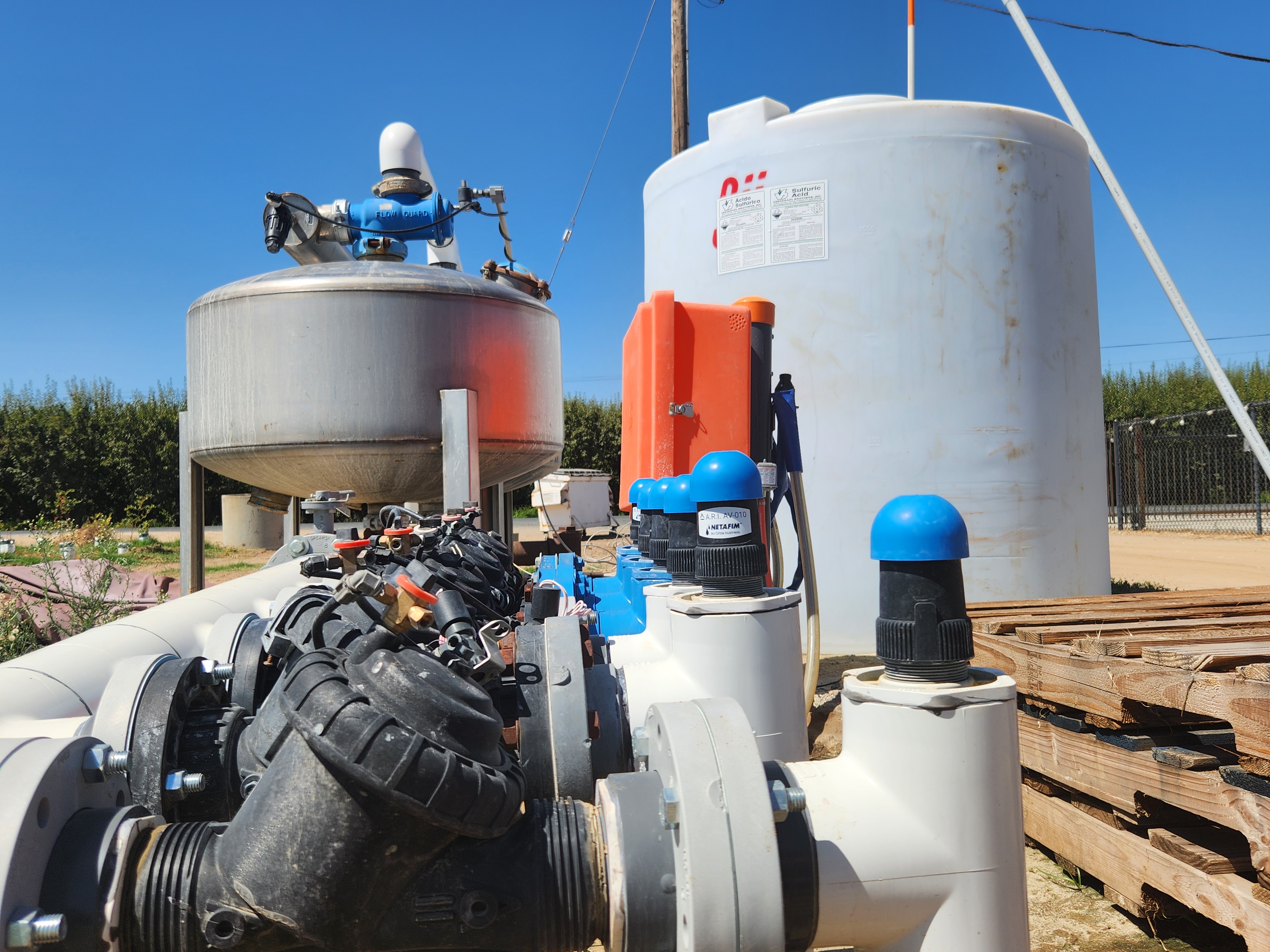
Sulfuric acid storage tanks at a pump station used for blueberry irrigation

Sulfuric acid storage at a typical pump station. The infrastructure requirement and safety risk are significant compared to a CO₂-based system.

How carbonic acid affects soil health compared to sulfuric acid

What the Soil Data Shows

The most direct comparison available comes from a side-by-side Haney test conducted on a pistachio orchard in the Central Valley – the same farm, same water source, same season. One section used sulfuric acid. One section used carbonic acid (ECO2MIX). The soil samples were compared after one full irrigation season.

Haney Test Results – One Season, Same Farm, Pistachio

Microbiome diversity – Sulfuric acid ↓ 12.95%
Microbiome diversity – Carbonic acid ↑ 12.34%
CO₂ respiration – Sulfuric acid ↓ 16%
CO₂ respiration – Carbonic acid ↑ 69%
Soil organic matter – Sulfuric acid ↓ 4%
Soil organic matter – Carbonic acid ↑ 124%
Total organic carbon – Sulfuric acid 115.79 → 106.72 ppm ↓
Total organic carbon – Carbonic acid 112.61 → 264 ppm ↑

These are not marginal differences. CO₂ respiration measures how actively soil microorganisms are metabolizing organic matter – the engine of nutrient cycling. Soil organic matter is the foundation of long-term soil health and water-holding capacity. Both went in opposite directions on the same farm, in the same season, with the only variable being the acid used for water pH control.

ECO2MIX BeCrop soil health results from strawberry fields

Safety: What Each System Requires

Sulfuric acid at 98% concentration is a Class I hazardous material. On-farm storage requires secondary containment, emergency response protocols, full PPE, and regular inspection. Skin contact requires immediate washing to prevent permanent damage.

Carbonic acid uses CO₂ – the same gas in a soda machine. No hazmat storage, no PPE requirement, no corrosion risk.

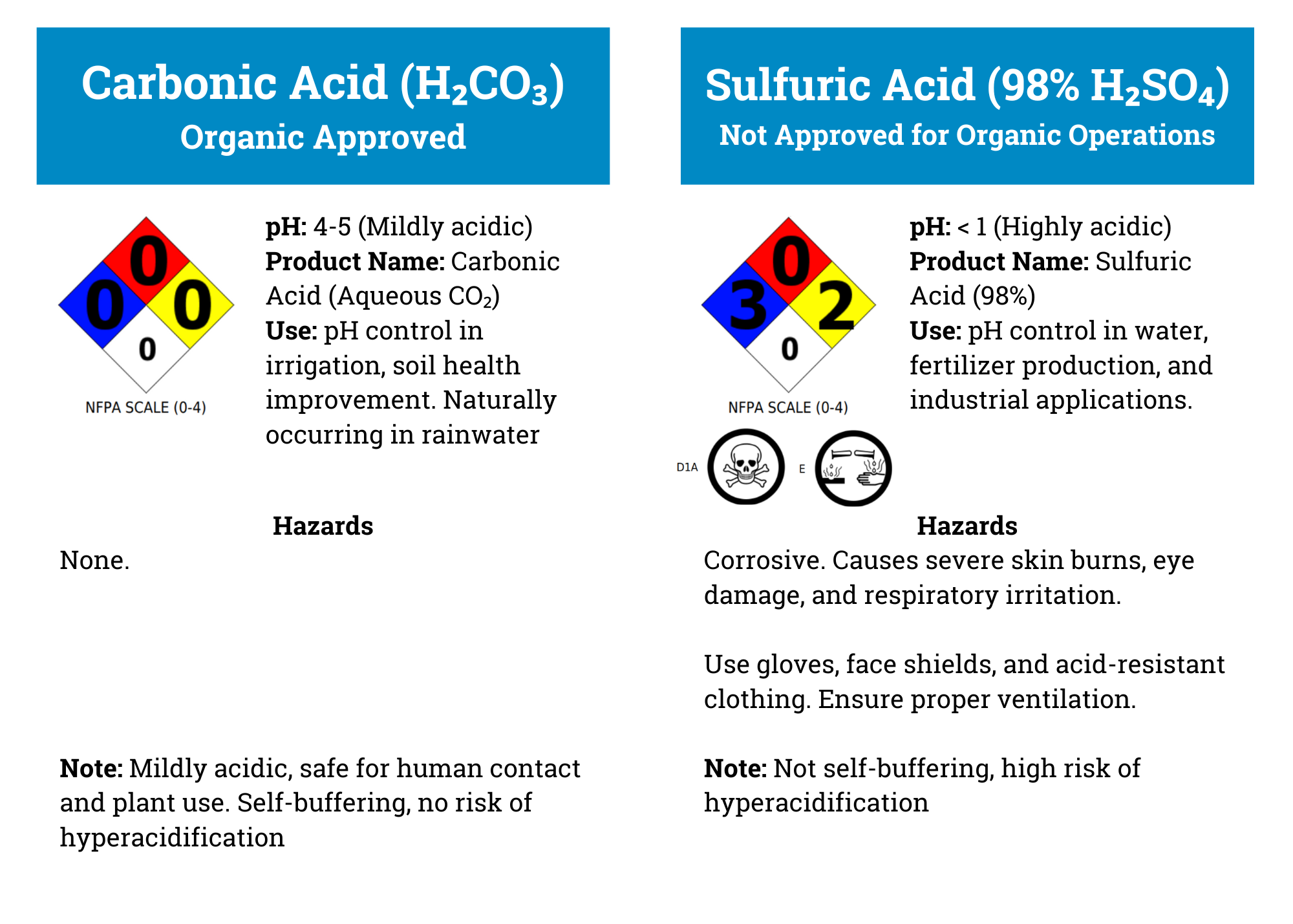
Safety Data Sheet comparison between carbonic acid and sulfuric acid

A side-by-side of the Safety Data Sheets for carbonic acid and sulfuric acid shows the contrast in handling requirements.

Side-by-Side Comparison

Factor Carbonic Acid (ECO2MIX) Sulfuric Acid Injection
pH control effectiveness Reaches target pH 6.5 and lower; probe-driven, continuous feedback Effective; fixed injection rate, less dynamic adjustment
What it leaves in soil CO₂ + H₂O – feeds soil biology, no ion residue Sulfate (SO₄²⁻) – adds to EC, salt load
Hyper-acidification risk None – self-limits around pH 5.0 Yes – strong acid, narrow margin for error
Effect on soil biology Positive – stimulates microbes, glomalin production, carbon cycling Neutral to negative – suppresses biology over time
Effect on soil EC Neutral to decreasing – no ions added Increasing over time – sulfate accumulates
Safety requirements None beyond CO₂ handling – same as a commercial beverage system Hazmat storage, PPE, spill protocols, skin burn risk
Organic certification CCOF-approved; NOSB pending USDA list inclusion Not permitted for organic operations
Equipment model Monthly service – system, CO₂, calibration, monitoring included Capital purchase; ongoing acid cost and maintenance
Energy use 1 HP motor Minimal
Corrosion to equipment None at turf and ag pH targets Yes – corrodes pipes, fittings, pump components over time

The Organic Difference

Sulfuric acid is not permitted in certified organic operations. ECO2MIX carbonic acid is CCOF-approved and NOSB-approved for inclusion on the USDA National List of Allowed Substances – the only precise, automated water pH control option available to organic growers.

Organic only sign in front of tomato plants

We're able to see a reduction in inputs that we're having to sell the grower because we're improving the soil. The microbial health improvement is huge.

Silas Rossow Agronomist, California Ag Solutions

Common Questions

Does carbonic acid control water pH as effectively as sulfuric acid?
Yes. Both carbonic acid and sulfuric acid deliver the same target pH at the wetting front during irrigation. Both prevent scale, improve distribution uniformity, and increase nutrient availability. The difference is what each leaves behind in the soil and water.
What does sulfuric acid leave in the soil that carbonic acid does not?
Sulfuric acid dissociates to release sulfate ions (SO₄²⁻) that remain in the soil permanently. Sulfate contributes to electrical conductivity, adds to the salt load, and suppresses soil biology over time. Carbonic acid breaks back into CO₂ and H₂O – no sulfate, no chloride, no persistent ion residue.
Can sulfuric acid cause hyper-acidification?
Yes. Sulfuric acid is a strong acid with a narrow margin for error. A small over-injection drops irrigation water pH rapidly – into ranges that corrode equipment and damage soil biology. Carbonic acid is a weak acid that self-limits around pH 5.0. Hyper-acidification is not a concern with carbonic acid.
Is carbonic acid approved for organic operations?
Yes. ECO2MIX carbonic acid is approved by CCOF for water pH control in certified organic operations and has been approved by the National Organic Standards Board (NOSB) for inclusion on the USDA National List of Allowed Substances, pending final rulemaking. Sulfuric acid is not permitted in organic agriculture.
What are the safety differences between sulfuric acid and carbonic acid?
Sulfuric acid requires on-farm hazmat storage, full PPE, spill containment, and emergency washing protocols. Any skin contact requires immediate washing to prevent permanent damage. Carbonic acid (dissolved CO₂) has no storage hazard, no corrosion risk, and no personal protective equipment requirement for normal operation. CO₂ is the same gas used in soda machines.
Why does sulfuric acid create injection distribution challenges?
Sulfuric acid has a density of 1.84 g/mL – 84% heavier than water. It sinks and concentrates rather than mixing evenly in the irrigation stream. CO₂ dissolves readily under pressure without the same distribution problems.

Ready to Move Away from Sulfuric Acid?

ECO2MIX is a fully managed service – the system, CO₂, calibration every 6–8 weeks, and remote monitoring are all included. No upfront equipment cost, no hazmat on the farm.