Carbonic Acid and Bicarbonates in Irrigation Water

If your inputs are underperforming and your soil test looks fine, the variable you haven't tested is probably your water.

Before / After

Bicarbonates are invisible on the leaf and invisible on the soil test — but they are doing damage in the water line and at the wetting front every time you irrigate. Understanding the chemistry tells you exactly what changes and what doesn't when you treat the water.

Before — High-Bicarbonate Water Untreated
  • Water arrives at pH 7.8–8.2; nutrients lock out at the wetting front
  • Scale forming in emitters; distribution uniformity declining
  • Phosphorus, iron, zinc tied up — inputs underperforming
  • Soil pH creeping up with every irrigation season
  • Calcium tied as CaCO₃ — unavailable to plants
After — Carbonic Acid Treatment
  • Water arrives at pH 6.5; nutrients stay soluble during active uptake
  • Scale stops forming; emitters stay clear
  • Phosphorus, iron, zinc available at the root zone
  • No sulfate, chloride, or ion residue added to soil
  • CO₂ dissolves CaCO₃ — calcium made plant-available
The mechanism is carbonate speciation: at pH 6.5, roughly half of all bicarbonate converts to carbonic acid — and carbonic acid breaks back into CO₂ and water, leaving nothing behind.

What Bicarbonates Do in Soil and Water

Alkalinity measures a water source's ability to neutralize acid — its buffering capacity. In most agricultural and turf irrigation water, bicarbonate (HCO₃⁻) is the dominant species driving that alkalinity reading. Alkalinity above roughly 150 mg/L as CaCO₃ is a concern for most crops and turf; bicarbonate above about 120 mg/L starts to cause problems.

The effects are both physical and chemical. Inside pipes and drip emitters, bicarbonate combines with calcium and magnesium at higher pH to precipitate calcium carbonate (CaCO₃) — the white scale that narrows emitters, reduces flow, and lowers distribution uniformity. In the soil, high-bicarbonate water arriving at elevated pH pushes the soil solution toward alkaline conditions that lock up phosphorus, iron, manganese, and zinc. Plants respond with yellowing leaves, reduced root growth, and lower nutrient use efficiency.

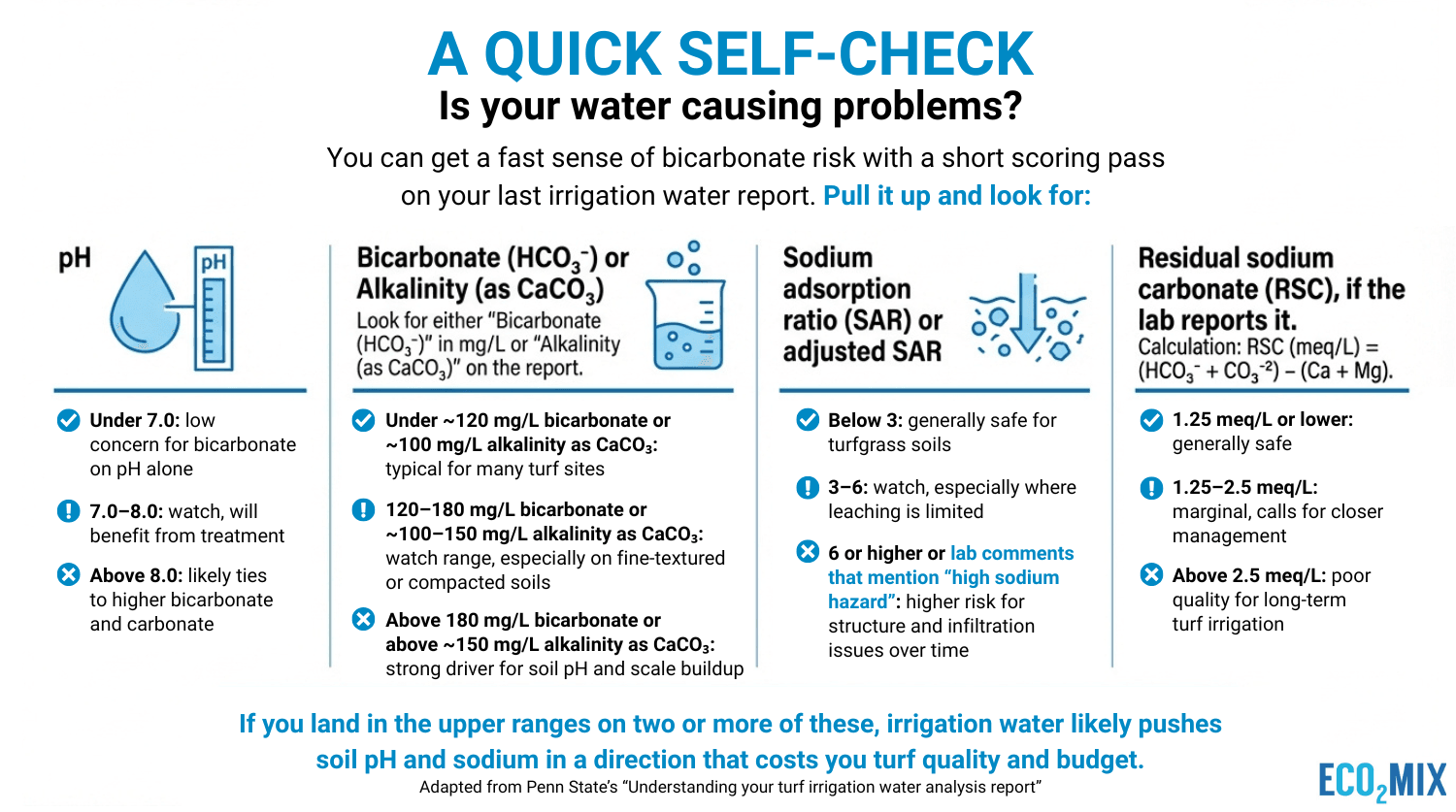
Quick reference guide for checking bicarbonate levels from a water report

Key numbers to read from your water report: pH, HCO₃⁻ in mg/L, and alkalinity as CaCO₃.

How Carbonic Acid Changes Bicarbonate Levels

Carbonic acid forms when CO₂ dissolves in water:

CO₂ + H₂O ⇌ H₂CO₃ ⇌ H⁺ + HCO₃⁻

The form that carbon takes in the water depends on pH — this is called speciation. Saruhashi (1955) published the defining tables: at pH 8.0, roughly 98% of the carbon in solution exists as bicarbonate (HCO₃⁻). At pH 6.3 — the crossover point — H₂CO₃ and HCO₃⁻ are at equal concentrations. Targeting pH 6.5 converts roughly half of all bicarbonate to carbonic acid.

At pH 6.3 H₂CO₃ = HCO₃⁻ (Saruhashi crossover)
At pH 6.5 target ~50% of bicarbonate converted to carbonic acid
Alkalinity change from adding CO₂ Zero — alkalinity is unchanged (Wolf-Gladrow et al., 2007)

When carbonic acid lowers irrigation water from pH 8.0 to pH 6.5, it is converting existing bicarbonate into carbonic acid — not adding new bicarbonate. The pH goes down because of the H⁺, but the alkalinity stays the same.

Chart showing how carbonic acid, bicarbonate, and carbonate species shift with pH

Carbon speciation at different pH values. At pH 6.5, roughly half of the bicarbonates have shifted to carbonic acid. Source: Saruhashi (1955).

How CO₂ Makes Calcium Available

Carbonic acid does not stop at adjusting the pH of free water. CO₂ present in treated irrigation water and in the soil atmosphere reacts with calcium carbonate (lime) in the soil:

CaCO₃ + CO₂ + H₂O ⇌ Ca²⁺ + 2HCO₃⁻

This reaction converts solid calcium carbonate — a form unavailable to plants — into dissolved calcium ions (Ca²⁺) that the plant can actually take up. The liberated bicarbonate is more mobile and can leach through the soil profile rather than accumulating near the root zone.

What Water pH Control with Carbonic Acid Actually Changes

Carbonic acid water pH control targets the soil solution at the wetting front — the pH the plant encounters during active feeding. Water pH control is not primarily about reducing the alkalinity reading on a water report. It is about delivering water at the right pH so nutrients are soluble when the plant needs them. What remains in the soil after carbonic acid treatment is CO₂ and H₂O: no sulfate, no chloride, no contribution to rising electrical conductivity over time.

Reading Your Water Report for Bicarbonate Risk

The key numbers to check:

  • pH — above 7.5 is a concern; above 8.0 is significant for most crops and turf
  • Bicarbonate (HCO₃⁻) — above 120 mg/L is a concern; above 180 mg/L is high
  • Alkalinity as CaCO₃ — above 150 mg/L is a concern for turf; above 200 mg/L for most crops warrants treatment
  • SAR (Sodium Adsorption Ratio) — elevated SAR combined with high bicarbonate accelerates sodium hazard
  • RSC (Residual Sodium Carbonate) — positive RSC indicates the water will deposit carbonates in the soil
Matrix guide showing how gases behave in irrigation water at different conditions

Research Evidence

Lampreave et al. (2022) studied carbonated irrigation water in calcareous vineyards with iron chlorosis — conditions similar to high-bicarbonate agricultural water. At approximately pH 6.5, carbonated irrigation increased phosphorus, iron, manganese, zinc, and calcium availability in the leaf tissue. Yield increased approximately 30–42% per vine by year three. Chlorophyll content increased from 2.13 to 3.41 mg/g dry weight. Leaf iron nearly doubled.

ECO2MIX has documented declining soil EC in internal field sampling from farms treated with carbonic acid. Two mechanisms drive this: no salt ions are added by carbonic acid, and lower-pH irrigation water at the wetting front improves infiltration and helps existing bicarbonates and salts leach through the soil profile.

We're able to see a reduction in inputs that we're having to sell the grower because we're improving the soil. The microbial health improvement is huge.

Silas Rossow Agronomist, California Ag Solutions

Common Questions

Does carbonic acid raise bicarbonates in irrigation water?
No. Carbonic acid does not raise alkalinity or increase bicarbonates. Adding CO₂ to water lowers pH by converting existing bicarbonate to carbonic acid – the opposite of the concern. Alkalinity is unchanged because the bicarbonate ion and the hydrogen ion cancel each other out in the alkalinity equation.
What are bicarbonates in irrigation water and why do they matter?
Bicarbonates (HCO₃⁻) are the primary source of alkalinity in most irrigation water. High bicarbonate levels cause scale buildup in pipes and emitters, reduce distribution uniformity, tie up nutrients like calcium and phosphorus, and push soil pH upward over time.
How does carbonic acid reduce bicarbonates?
When CO₂ dissolves in water it forms carbonic acid (H₂CO₃), which releases hydrogen ions (H⁺). Those ions react with existing bicarbonate (HCO₃⁻) to form more carbonic acid, converting bicarbonate to a less reactive form. At pH 6.5, roughly half of the bicarbonates have become carbonic acid – reducing their concentration in the water.
Does carbonic acid add salts or raise electrical conductivity?
No. CO₂ is a neutral volatile molecule. It leaves no sulfate, chloride, or sodium ions behind. After the irrigation event, carbonic acid breaks back into CO₂ gas and water. Unlike sulfuric acid, it does not contribute to salt accumulation or rising electrical conductivity in the soil.
Is carbonic acid effective even though it is a weak acid?
Yes. In a pressurized drip or sprinkler system, dissolved CO₂ maintains a stable target pH through the mainline. ECO2MIX systems routinely hold 6.5–6.7 pH, and some farms run at 5.8–6.2 pH with every irrigation event. The weak-acid characteristic also means the system cannot hyper-acidify – carbonic acid self-limits around pH 5.0 under normal conditions.
What happens to carbonic acid in the soil after irrigation?
Carbonic acid degasses back to CO₂ and H₂O as pressure drops after irrigation. In pot studies, water pH returned to baseline within 40–120 minutes. In the field – with subsurface drip, natural soils, and frequent irrigation – the treated soil solution pH stays optimal for much longer, covering the full feeding window while the plant is actively taking up nutrients.

Questions About Your Water pH?

ECO2MIX provides a fully managed carbonic acid service — the system, CO₂, calibration, and monitoring are all included. No upfront equipment cost.