On This Page
Alkaline Water, Water Alkalinity and Acidification
When water pH is above 7.0, then it will be referred as alkaline water. While water alkalinity is only related to the water pH, as it establishes the buffer capacity of the water. This is the capacity of water to neutralize acids. For example, two cups of water with the same pH, but if one of them had a greater alkalinity, would take more acid to decrease 1 unit of pH in the water with a higher alkalinity. Water alkalinity is reported as solely the total carbonates in the water, because they represent more than 90% of water alkalinity, as presented in [1] where m is molal concentration.
[1] mH ≈ 2mCO₃²⁻ + mHCO₃⁻
Acceptable levels for greenhouse use is up to 400 ppm or 8 meq/L of CaCO₃. In the case of plug seedlings, total carbonates in the water must be lower than 1.5 meq/L because of the small volume of the substrate (Bailey & Bilderback 1997).
The chemistry of soil acidification, takes into account the proton budget of different processes that are modifying the chemical composition of soils and soil water. The cation-exchange complex (CIC) is one of the most important soil characteristics, and its main components are the negative charges present on clay minerals and soil organic matter. Acidification is a complex set of processes. The acidity is increased either by a direct increase in H⁺, or by increase of exchangeable Al³⁺ by the reaction of H⁺ with the soil minerals. Great sources of H⁺ in natural acidification processes include CO₂ dissolved in water, cation assimilation, nitrification and atmospheric acid deposition.
The acidification effects in the soil, meaning the sinks of the H⁺, are the chemical weathering of soil particles and the cation exchange, this is going to affect the displacement of cations from the soil particles. The process of soil acidification by strong acids, such as sulfuric acid, nitric acid or phosphoric acid, is through the replacement of base cations (Ca²⁺, Mg²⁺, K⁺, Na⁺) on the soil exchange places. Then, the base cations are leached associated with the strong acid anions (SO₄²⁻, NO₃⁻, PO₄³⁻). While the soil acidification by carbonic acid, occurs when the CO₂ dissolves on water, turning in to Dissolved Inorganic Carbon (DIC), which consist of carbonates and bicarbonates (HCO₃⁻, CO₃²⁻, H₂CO₃*(CO₂(aq) + H₂CO₃)). The dissolved CO₂ in water may react with minerals of the soil, including feldspars and calcite, as presented in [2].
[2] n/2M₂/ₙO + nCO₂ + n/HCO₃⁻ = M^n+ + nHCO₃⁻
The degassing of CO₂ from the system has no effect in the water alkalinity, as it removes the same amount of H⁺ and HCO₃⁻. Production of bicarbonate in the soil is part of the acidification process, as H⁺ replace base cations in the soil exchange sites. Base cations then forms bicarbonate by associating to the anion HCO₃⁻. As the dissolved bicarbonate and the other DIC compounds percolates, the carbon becomes stored on inaccessible depths of the soil along with the base cations (Reuss & Johnson 1986, Mulder & Cresser 1994, Andrews & Schlesinger 2001). The acidification of salty irrigation water has also benefits for the soil, with the potential effect of improving the water quality. Between the soil benefits of irrigation water acidification, the lowering of the electro-conductivity of the soil and increasing the hydraulic conductivity have been described (Abd El-Hady & Shaaban 2010).
Sulfuric Acid
The irrigation water acidification using sulfuric acid is a popular practice in California, Washington and eastern Oregon. (Davis et al. 2014). Compared to other strong acids, such as nitric acid and phosphoric acid, the sulfuric acid anion (SO₄²⁻) binds more weakly than the phosphoric acid anion (PO₄³⁻), but stronger than the nitric acid anion (NO₃⁻) (Mulder & Cresser 1994). Usually, water with high pH are rich in sodium and boron. In arid soils the boron toxicity caused by water is a common issue, due to the use of high boron irrigation water. The leaching of the boron from the soil can be achieved, although it needs triple water volume as the one needed for other salts. Plus, in alkaline soils the boron is relatively immobile, so it makes the boron leaching more difficult. Sulfuric acid as a soil amendment for the recovery of high boron and sodium soils, was indicated by Prather (1977). The boron removal has been associated to two main mechanisms, adsorption by soil particles of boric acid and borate ions and chemical precipitation (Keren & Bingham 1992). If the irrigation doesn’t account over-irrigation for the boron excess, it would become more available in the soil solution over time with an acidification of the soil. On the other hand, the use of sulfuric acid to reclaim sodic soils is a common and effective practice in agriculture. The fast reaction of the sulfuric acid with the calcium and magnesium carbonates, release the Ca that replace the Na from the exchange sites of the soil particles, for a wash out with an over irrigation with a non-saline water. Adding sulfuric acid only makes sense when there is lime on the soil (Mainly CaCO₃, but may also have MgCO₃, CaO and MgO) or when the pH is basic.
The overdosing of sulfuric acid has not been reported as an issue, although its use in the irrigation water increase the movement of plant nutrients in the soil. Being a risk to over-apply, especially to nitrates and other mobile nutrients. There are two possible scenarios. One scenario, would make the hydrogen and sulfate ions to leach to the groundwater, and contaminate the aquifer. The second possible scenario is the adsorption scenario. If it happens, nutrients such as potassium, calcium and magnesium, would be removed from the soil. As the H⁺, in presence of sulfuric acid, are able to trade places with the nutrients in the adsorption places of clay and soil particles. Washing out the nutrients of the top soil into the inaccessible subsoil. The strongly acid soils, also hinders the bacteria that decompose the organic matter, main nitrogen source in agricultural land (USDA, 2006).
Sulfur Dioxide
The Harmon SO₂ generator produced on the 50’s, was the first sulfur burner for agriculture. The burning of the sulfur produces SO₂ gas, this gas is mixed with irrigation water and reacts forming sulfuric acid, that generates the water acidification (Sanden et al. 2016). The acidifying potential of H₂SO₄ is largely determined by the Fe and Al oxides present on the soil, by the displacement of an -OH as shown in [3] and [4]. Both mechanisms increase the cation exchange. Sulfate adsorption increases as the pH goes down, but is negatively affected by the presence of organic matter (Mulder & Cresser 1994).
[3] Oxide-OH⁰ + SO₄²⁻ = Oxide-SO₄²⁻ + OH⁻
[4] Oxide-OH₂⁺ + SO₄²⁻ = Oxide-SO₄²⁻ + H₂O
The use of 5% of water treated with sulfur burners has shown to affect only water pH, not affecting soil pH or the available nutrient levels. Larger quantities of water treated with sulfur dioxide could affect soil pH. John Wantulok in the text “Where Oh Where has my sulfur gone?”, points out that even when the sulfur burner should be more efficient in comparison to the sulfuric acid injection, this is not so since both use 186 lb. of sulfur per one million gallons of water. The growers that use this system don’t reflect this situation. In a survey to users of the sulfur burner, they were actually using 300 to 600 pounds of sulfur per 1 million gallons of water. The excess of sulfur needed in comparison to the sulfuric acid injection, would come from the uncontrolled burning of the sulfur. Being part of the sulfur oxidize and applied though the water as sulfur powder, it does not have any effect on the water pH. The system also requires a booster pump to reinject treated water in the mainstream, increasing energy cost. The basic technology involved in the sulfur burning, generates an abrupt change in water pH.
Carbon Dioxide
Inorganic carbon-bearing compounds in the soil environment are the gaseous and aqueous CO₂, dissolved carbonic acid, bicarbonate and carbonates, plus the precipitated carbonates. Soil chemistry involving the CO₂, HCO₃⁻, CO₃²⁻ and solid carbonates is complicated, because of mineral precipitation and ion pair formation. J.C. Fontes, one of the most important geochemical exponents of the XX century, and J.M Ganier established that the normal assumption is that the inorganic carbon is released into the solution when CaCO₃ and MgCO₃ are dissolved, the carbonic acid concentration is equal to the molality of Ca²⁺ and Mg²⁺.
There are three considerations to make: first, dissolution of gypsum can provide Ca²⁺; second, cation exchange can substitute Ca²⁺, Mg²⁺ ions for K⁺, Na⁺ ions in the solution with molar ratio 2:1; and third, NaCO₃ may also be leached, taking the sodium out of the top soil. Second and third considerations will give an excess of alkali ions, with respect to chlorides and nitrates. These assumptions are presented in [5], where m denotes mole concentration (Fontes & Garnier 1979). This ion equilibrium, shows that carbonic acid (formed with the CO₂ dissolved in water) is able to create a cation exchange in the soil, just like the nitric acid, sulfuric acid and phosphoric acid. Despite of the organic matter and the oxides present in the soil, the sulfuric acid is not advisable.
[5] 2mCO₃²⁻ + mHCO₃⁻ = mCa²⁺ + mMg²⁺ - mSO₄²⁻ + mNa⁺ + mK⁺ - mCl⁻ - mNO₃⁻ / 2 2
In the case of the sodic soils and water, the SAR is a measure of the risk of sodium levels. An infiltration issue can be generated, if the sodium in relation to calcium and magnesium are not in balance. The adjusted SAR takes in account the carbonates and Ca²⁺ ratio, in order to correct the Sodium Adsorption Ratio (SAR). The Ca²⁺ content changes as minerals dissolved in irrigation water (increase) or when carbonates precipitate (decrease). But the dissolution of CO₂ in water increases the dissolved Ca²⁺ in the irrigation water, thus reducing the sodium risk of negative effects (FAO 1985). The carbonates precipitation as shown in [6] and [7], occurs when soil water content or the dissolved CO₂ is decreased. Calcite (CaCO₃) reacts with the H⁺ from the carbonic acid, releasing Ca and bicarbonate ions. So applying irrigation water with high amounts of dissolved CO₂, helps avoid the carbonate precipitation, that is associated with scaling inside of pipes. Depending on the quality of the irrigation water and the amount irrigated, the carbonates can be either precipitated or dissolved and leached.
[6] CaCO₃ + H₂O + CO₂ = 2HCO₃⁻ + Ca²⁺
[7] MgCO₃ + H₂O + CO₂ = 2HCO₃⁻ + Mg²⁺
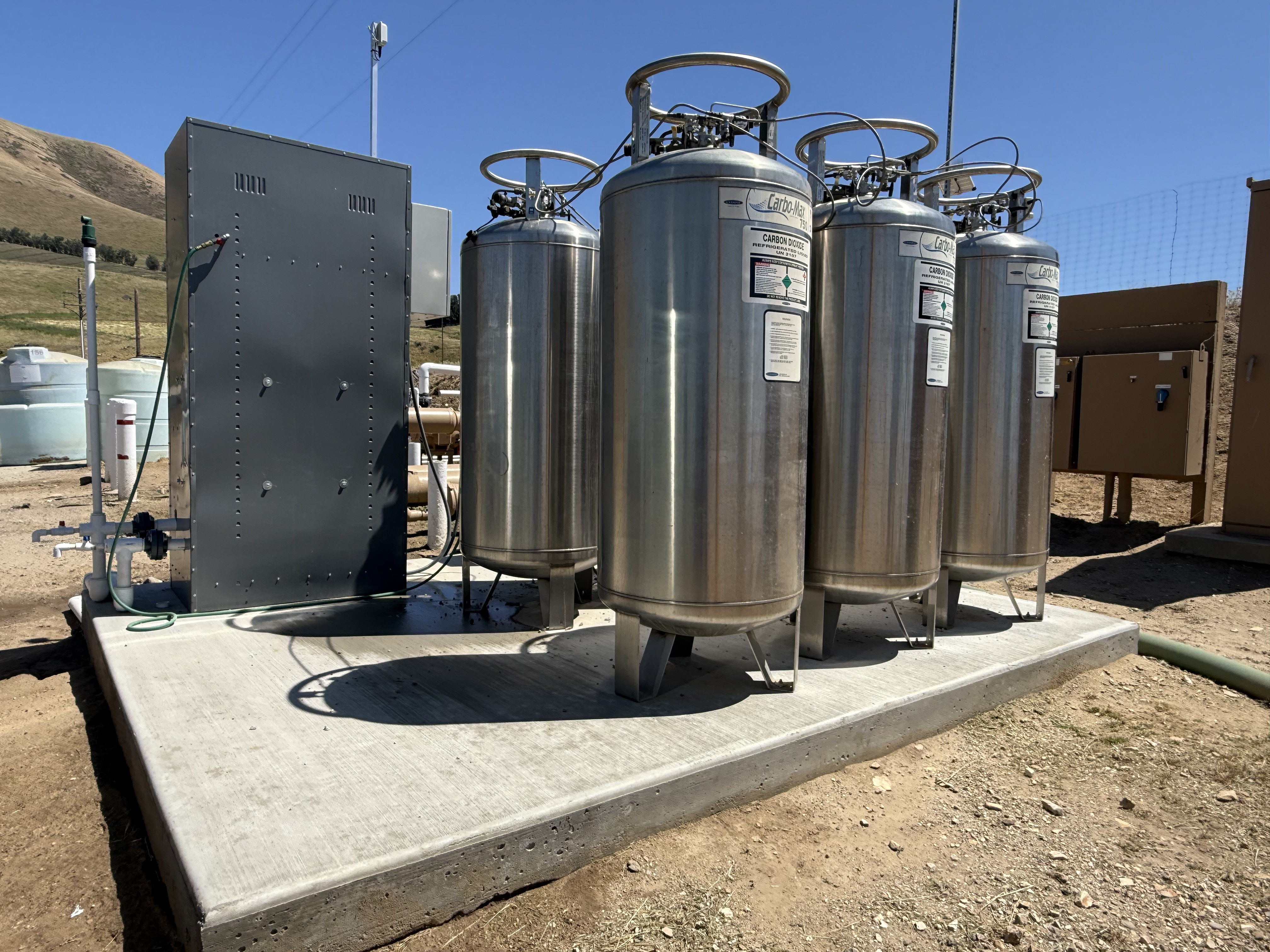
The technology involved in the CO₂ injection in irrigation water, allows a direct injection without the use of additional energy. Also it can be easily automatized, as a simple measure of the water pH can regulate the CO₂ injection. Making it able to maintain a constant water pH.
Specific Benefits of the Carbonic Acid in the Water
Dissolved Inorganic Carbon (DIC)
Essential plant nutrients are those without which plants cannot complete their life cycle. These are irreplaceable by other elements and are directly involved in plant metabolism. The three main nutrients are C, O and H, nutrients that plants takes though air and water. (Fageria 2016). The water uptake is though dissolved organic carbon (DOC) and dissolved inorganic carbon (DIC). DIC compounds have an origin in the CO₂ dissolved on water, resulting in the formation of carbonates and bicarbonates. Reported concentration of DIC on the soil moves in the range of 2,000 to 200,000 ppm. External root environment DIC concentration influences photosynthesis, respiration, NO₃⁻ uptake, partitioning of C and N. Particular positive effects from high DIC soil concentrations have been reported for plants under high irradiances, salinity stress and high shoot temperatures. High soil DIC concentrations maintains high DIC concentrations in root tissue, which have been reported to directly affect the plant metabolism.
Improved Enzymatic Activity
The activity of two enzymes in the root, the PEPc and carbonic anhydrase, are responsible for incorporating the DIC as organic acids or as carbon skeletons for amino acids by the root tissue. The reported increase in the initial NO₃⁻ uptake, has been observed associated to an increase in the Nitrate reductase activity with high DIC concentrations. The influence in many of plant physiological processes by the DIC concentration on the root zone, presents special interest when it comes to hydroponic and aeroponic systems. Also greater concentrations of CO₂ in the soil atmosphere resulted in soil weathering and soil acidification. (Andrews & Schlesinger 2001, Cramer & Titus 2001, Viktor & Cramer 2004). The recarbonation process (CO₂ injection in water) had been use as part of the softening of hard water. But as an amendment in the irrigation water, carbonated water has been evaluated on many crops.
For example, Cotton is one of the most responsive crops, trials with a charge of 1.5-1.8 g CO₂/L reported an increase in boll number, leaf area and dry weight. Yield increases have been reported in crops, with a 20% yield increase in wheat increased and a 7.8% increase in tomatoes under mulched conditions. But no increase in yield was reported in those same tomatoes, when there was no mulch used. The yield increase was associated to a small CO₂ air increase and to a general increase in the nutrient uptake. In calcareous soils the pH of the soil is believe to be lower in the rhizosphere, due to the CO₂ produced by the root and microbial respiration as part of a natural process. Being part of the normal root strategies for nutrient uptake (Hinsinger et al. 2003, Kirkham, 2016).
Specific Bacteria Sanitization
Carbon dioxide has also been reported as a water sanitization method, reducing the zoopore survival of Phytophthora sp., with a reduction of 90% at 4,000 ppm and of 40% from 125 to 2,000 ppm after a 2-hour exposure of irrigation water (Kong, 2013).
Final Remarks
The sulfuric acid in irrigation water has been successfully used for recovering boric and sodic soils, by leaching of the salts. As well as for water acidification, but its effect on soil acidification is decreased by organic matter. Also in major releases it hinders the bacteria that decompose soil organic matter, these are an important part of the plant nutrients source. Replacing the direct acid injection with sulfur burners had not the expected high efficiency, being needed more sulfur to avoid an uncertain and unstable water pH. The water acidification with captured CO₂ is seen as a useful way to reach a constant water pH, avoid scaling in pipes and the carbonate formation in the soil. It is one of the main acidification processes of nature, and it has been reported that the CO₂ released by roots in calcareous soils have an acidification effect. The dissolved CO₂ in water as DIC, might be an important nutrient to be considered as part of the hydroponics and aeroponics systems. The DIC concentration is known to have a direct benefit on the enzymes involved in nitrates uptake and root physiology.
Bibliography
Abd El-Hady M. & S.M. Shaaban. 2010. Acidification of saline irrigation water as a water conservation technique and its effect on some soil properties. American-Eurasian J. Agric. & Environ. Sci. 7(4):463-470.
Andrews J.A. & W.H. Schlesinger. 2001. Soil CO₂ dynamics, acidification, and chemical weathering in a temperate forest with experimental CO₂ enrichment. Global Biochemical Cycles 15(1):149-162.
Baily D. & T. Bilderback. 1997. Alkalinity control for irrigation water used in nurseries and green houses. North Carolina State Univ. Hort. Info. Lflt. 558.
Cramer M.D. & C.H.A. Titus. 2001. Elevated root zone dissolved inorganic carbon can ameliorate aluminum toxicity in tomato seedlings. New Phytologist 152 (1):29-39.
Davis J.G., R.M. Waskom & T.A. Bauder. 2014. Managing sodic soils. Colorado State University Extension Publication no.504. http://extension.colostate.edu/docs/pubs/crops/00504.pdf
Fageria N.K. 2016. The use of nutrients in crop plants. CRC Press.
FAO. 1985. Water quality for agriculture. Roma, Italia.
Fontes J.C. & J.M. Garnier. 1979. Determination of the initial 14C activity of the total dissolved carbon: A review of the existing models and a new approach. Water sources research 15(2):399-413.
Hinsinger P., C. Plassard, C. Tang & B. Jaillard. 2003. Origins of the root-mediated pH changes in the rhizosphere and their responses to environmental constraints: A review. Plant and Soil 248:43-59.
Keren R. & F.T. Bingham. 1992. Boron in water, soils and plants. In: Advances in Soil Science, Volume 1. Ed. B.A. Stewart.
Kirkham M.B. 2016. Elevated carbon dioxide. Impacts on soil and plant water relations. CRC Press.
Kong, P. 2013. Carbon dioxide as a potential water disinfectant for Phytophthora disease risk mitigation. Plant Dis. 97:369-372.
Mulder J. & M.S. Cresser. 1994. Soil and soil solution chemistry. In: Biogeochemistry of small catchments: A tool for environmental research. Ed. Moldan B. & J. Cerny. John Wiley & Sons.
Reuss J.O. & D.W. Johnson. 1986. Acid deposition and the acidification of soils and water. Springer, New York.
Sanden B., T.L. Prichard & A.E. Fulton. 2016. Improving water penetration. Fruit and nut research & information, UC Davis University of California.
USDA. 2006. Sulfuric Acid. Technical evaluation report. Crops.
Viktor A. & M.D. Cramer. 2004. The influence of root assimilated inorganic carbon on nitrogen acquisition/assimilation and carbon partitioning. New Phytologist 165(1):157-169.
Irrigation Water Acidification Using Captured CO2 — An Option to Traditional Acidification Systems
Technical analysis of how captured CO₂ provides an alternative to sulfuric acid and sulfur burners for irrigation water acidification, with benefits for soil health and sustainability.
Open PDF ↗Was this article helpful?
Thanks for your feedback!


Ready to Fix Your Water pH?
Get a Proposal