On This Page
Waldo Moraga of ECO2MIX presented this webinar for TurfNet on January 16, 2024, covering how carbonic acid water pH control works, what it leaves behind in the soil, and what superintendents have seen after installation. Topics include:
- Safety and sustainability compared to sulfuric acid and sulfur burners
- Probe-driven pH control and how ECO2MIX maintains a precise setpoint
- Soil health results from BeCrop and Haney tests at Seven Oaks Country Club and other sites
- Live poll results from the TurfNet audience on current pH control methods
Watch the full TurfNet webinar recording
Slide 1
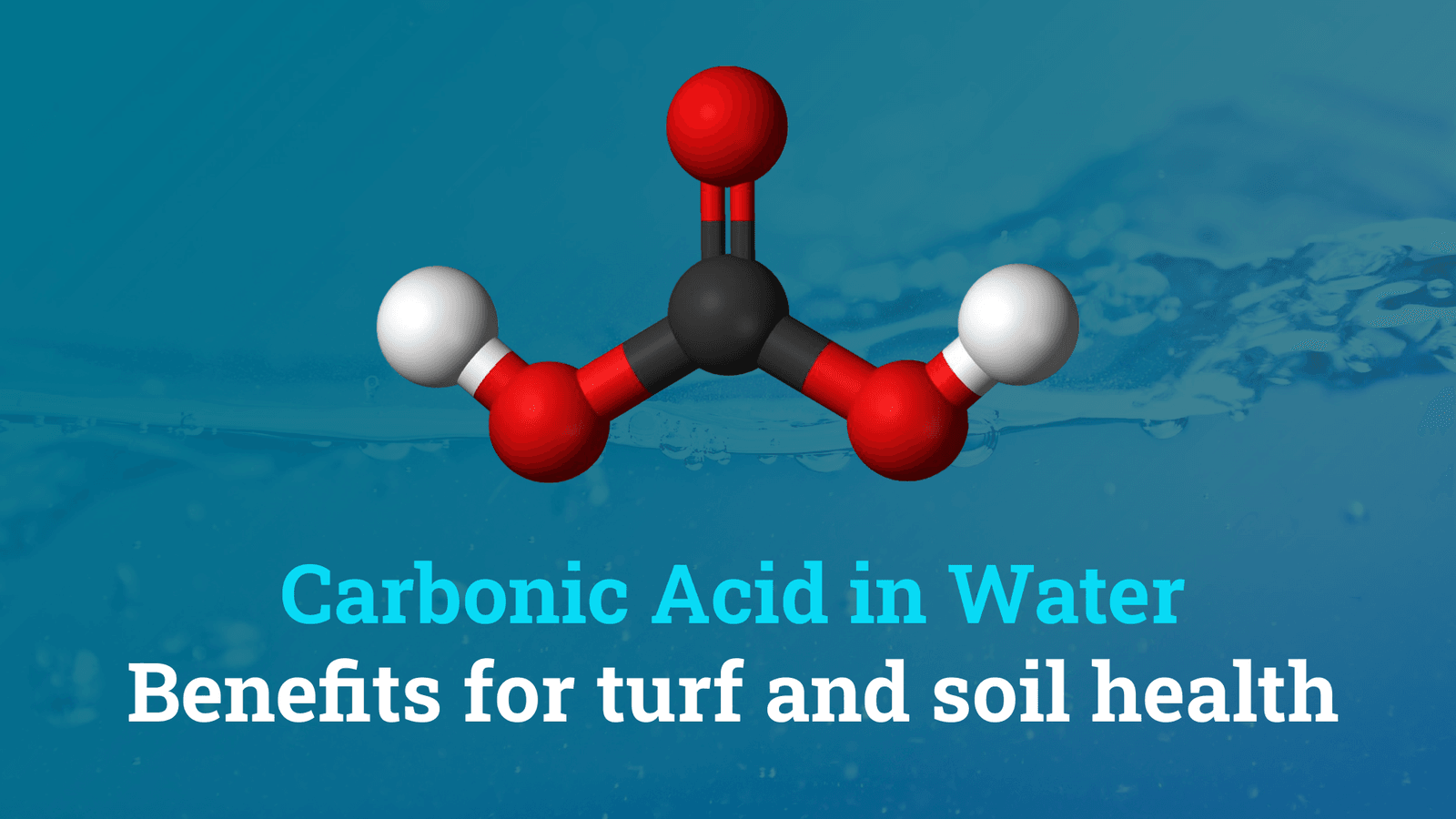
Hello everyone, and thank you John for having me here, and for giving us the opportunity to share what we have seen in the last 7 years using carbonic acid to adjust water pH, first in Ag and now in golf courses and turf. We’d like to show you how a better water pH control method can help the grass, the soil and highlight all the benefits of microbial activity we documented, either searching for previous research and/or for what we have seen after switching to a carbonic acid solution from the typical sulfuric acid or sulfur burners.
Poll — What method do you use to control water pH?
- Sulfuric Acid Injection — 25%
- Sulfur Burners — 6%
- Other — 25%
- None — 44%
Slide 2
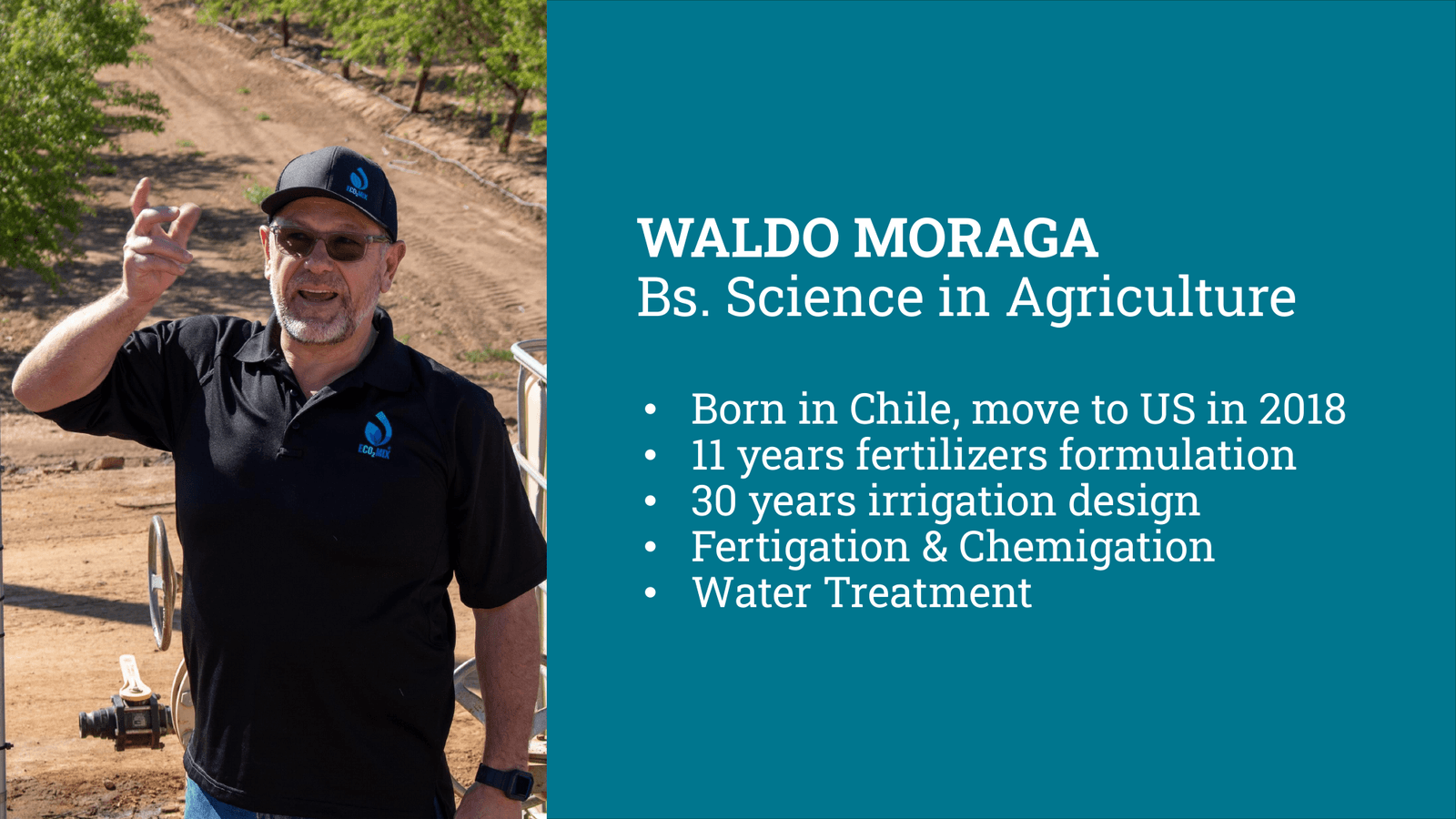
First a little bit about myself, I’m from Chile and I’ve been involved in Ag my whole life, first on fertilizers and since 1994 in irrigation design, all those years designing drip and micro sprinkler systems for AG, lead me to fertigation systems design, then water pH control, and finally water treatment, then is when I realize on the importance of water quality and what we can do to make it better for the plants and for the soil.
Slide 3
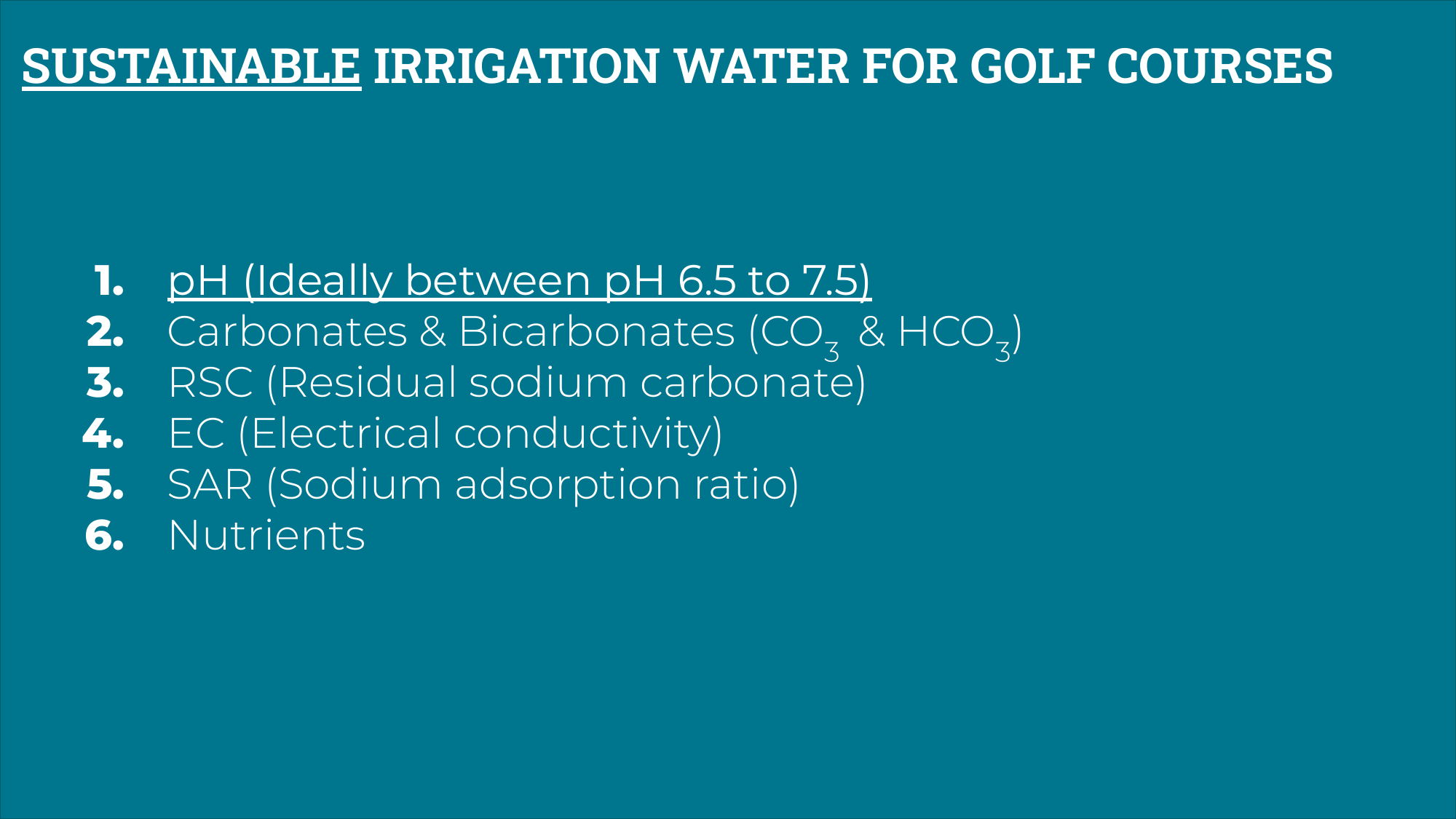
We have different factors that influence turf management, and water is probably the most important, especially when it comes to sustainability. We all deal with poor water quality, either if it comes from the city, from wells, or from the district. Water quality is most of the time not what we want, and always needs our attention. To me, there are six important parameters to consider when we look for good quality water: pH, bicarbonates, or carbonates if water pH is high, residual sodium carbonate, electrical conductivity, sodium adsorption ratio and nutrients.
Poll — Which of these six factors do you consider the most important for turf health?
- Water pH — 67%
- Bicarbonates/carbonates — 27%
- Residual sodium carbonate — 0%
- Electrical conductivity — 0%
- Sodium adsorption ratio — 7%
As you can see water pH is in first place, because water pH can influence most of those other parameters, making it easier or harder to manage them. We are going to talk today only about water pH. The ideal pH, for most of the plants and soil is between 6.5 to 7.5, and we know that, at least on the West Coast, when water comes from snow melt, or wells, the water pH is high, and we need to adjust it to slightly acid or neutral.
Slide 4
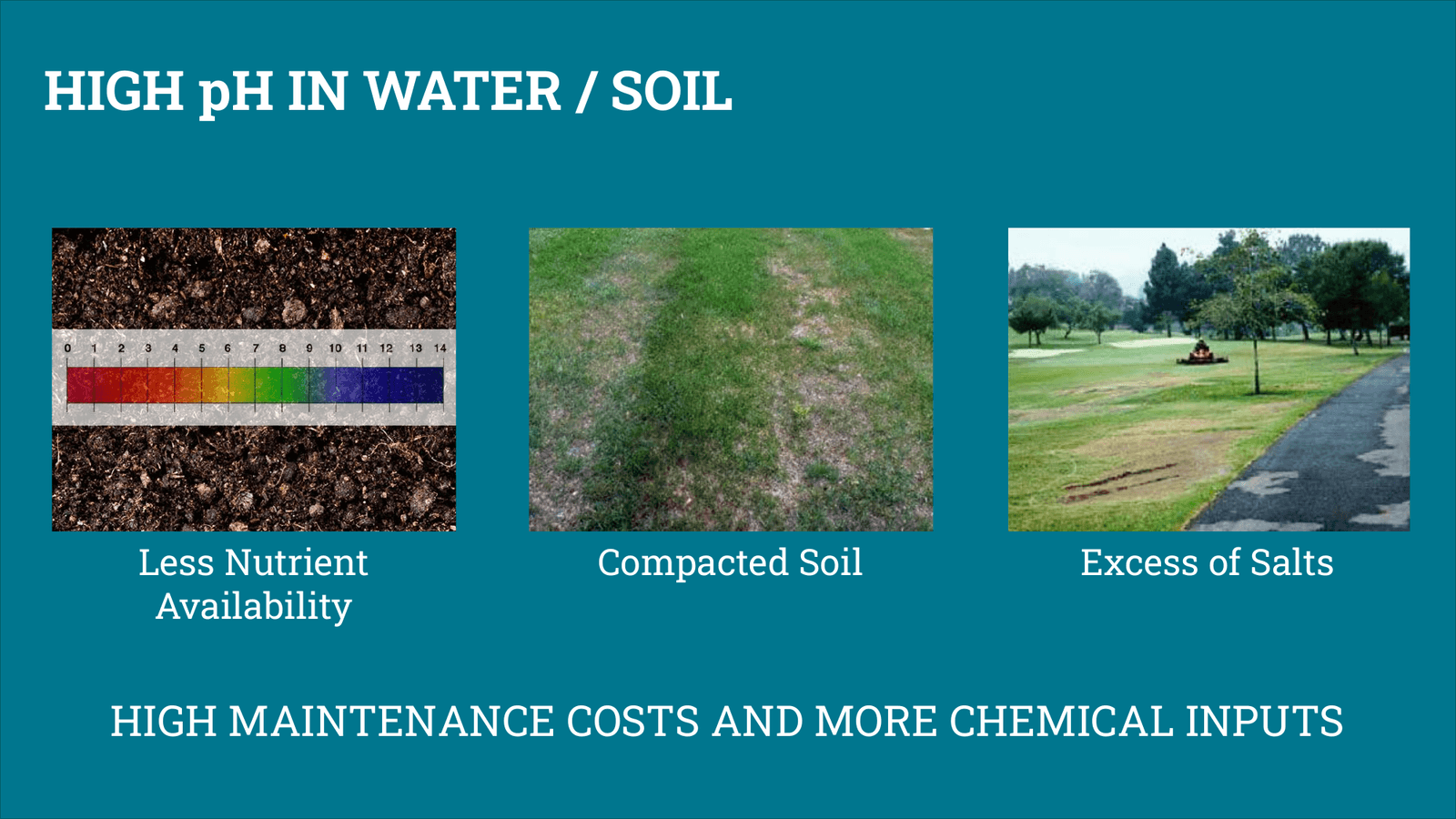
pH can be a problem either when it is in the water or in the soil, alkaline soils are easier to show an excess of salts, they are more compacted, and by consequence, they have less water penetration capabilities. But one of the most important problems with high pH is the nutrient availability, if the pH in the nutritive solution in the soil is not the right one, does not matter how much fertilizers we apply, the plant can not take it, you spend a lot of money on inputs, hoping to have your grass green and healthy, but if the pH is not the right one, it’s a waste of money, this also leads to more and more chemical inputs.
Slide 5
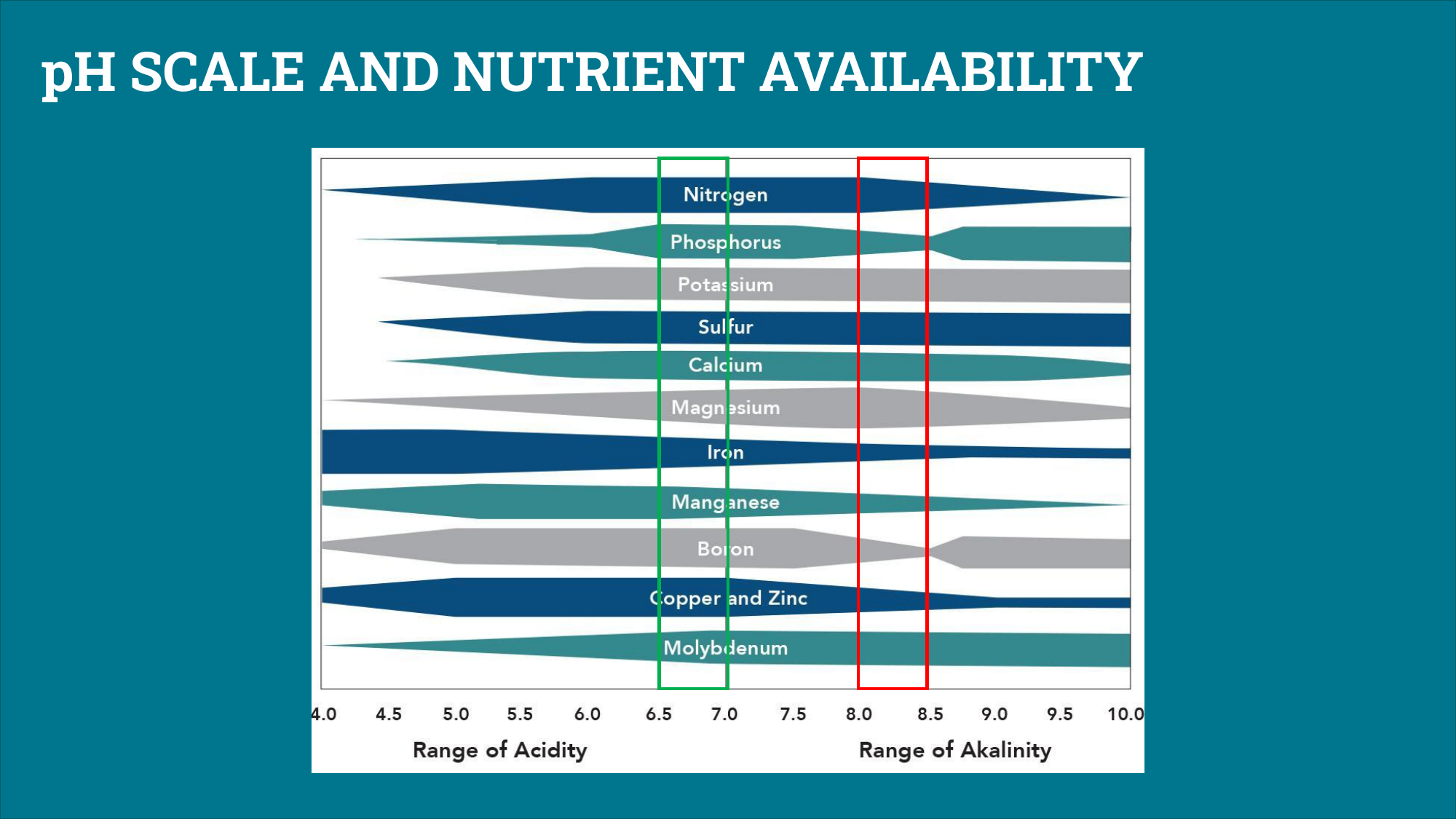
Let’s see how water pH influences the nutrient availability in the soil solution, we can see here that most affected nutrients are the micros:
- Iron — responsible for chlorosis on leaves and oxygen transport
- Manganese — important to grass growth, consumes nitrogen and participate in the photosynthesis process
- Copper — helps the cell wall strength and is very closely related to zinc
- Zinc — helps in enzyme activation, in water intake from the soil, helps hormones, and participates in temperature control
- Boron — important in root elongation, cell wall strength, and the utilization of Calcium and Phosphate
In this slide we can see how important is the solution pH to have all those nutrients available for the plant, even phosphorus it’s been affected by the pH.
Slide 6
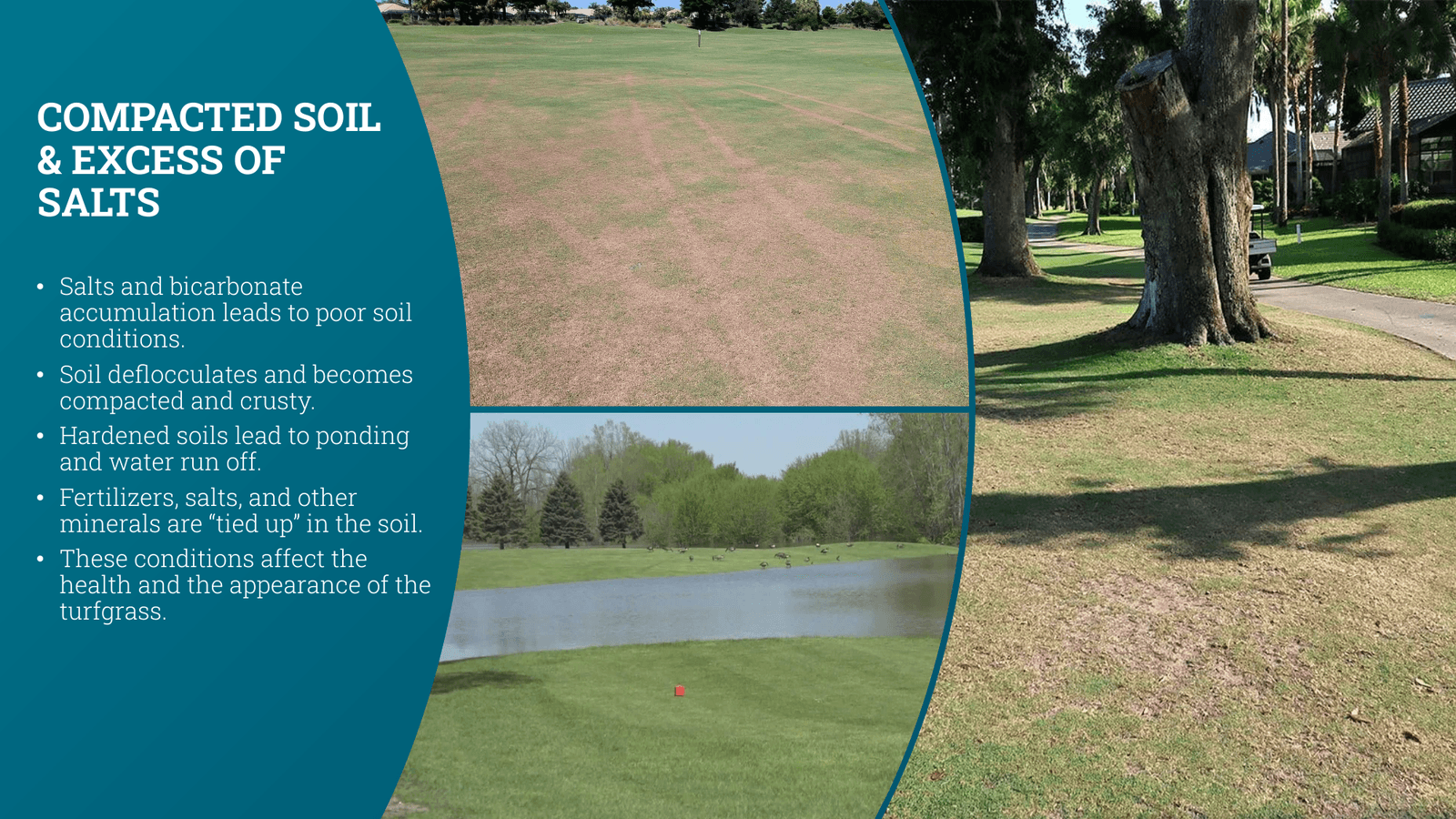
Another important issue with high pH in the water, is that usually high pH is associated with high bicarbonates in water, and as we know, bicarbonates only exist dissolved in water, increasing water pH. Bicarbonates get into the water when water passes through a calcium carbonate or limestone rock formation and/or magnesium carbonate or dolomite rock formation, that’s normally how water gets this high concentration of bicarbonates.
When applied water dries out, the bicarbonates in it combine with calcium and magnesium in the soil, locking them up, and by consequence, we have less soluble calcium and magnesium available for the plants, other issues are the excess of salts, and soil compaction. Soil defloculates and becomes compacted and crusty, increasing water run-off. Nutrients and salts are tied up in the soil, and the appearance of the turf is not what we’re looking for.
Everything in nature needs a balance, and the excess or lack of something is responsible for unbalanced development and growth, in this case of our turf.
Slide 7
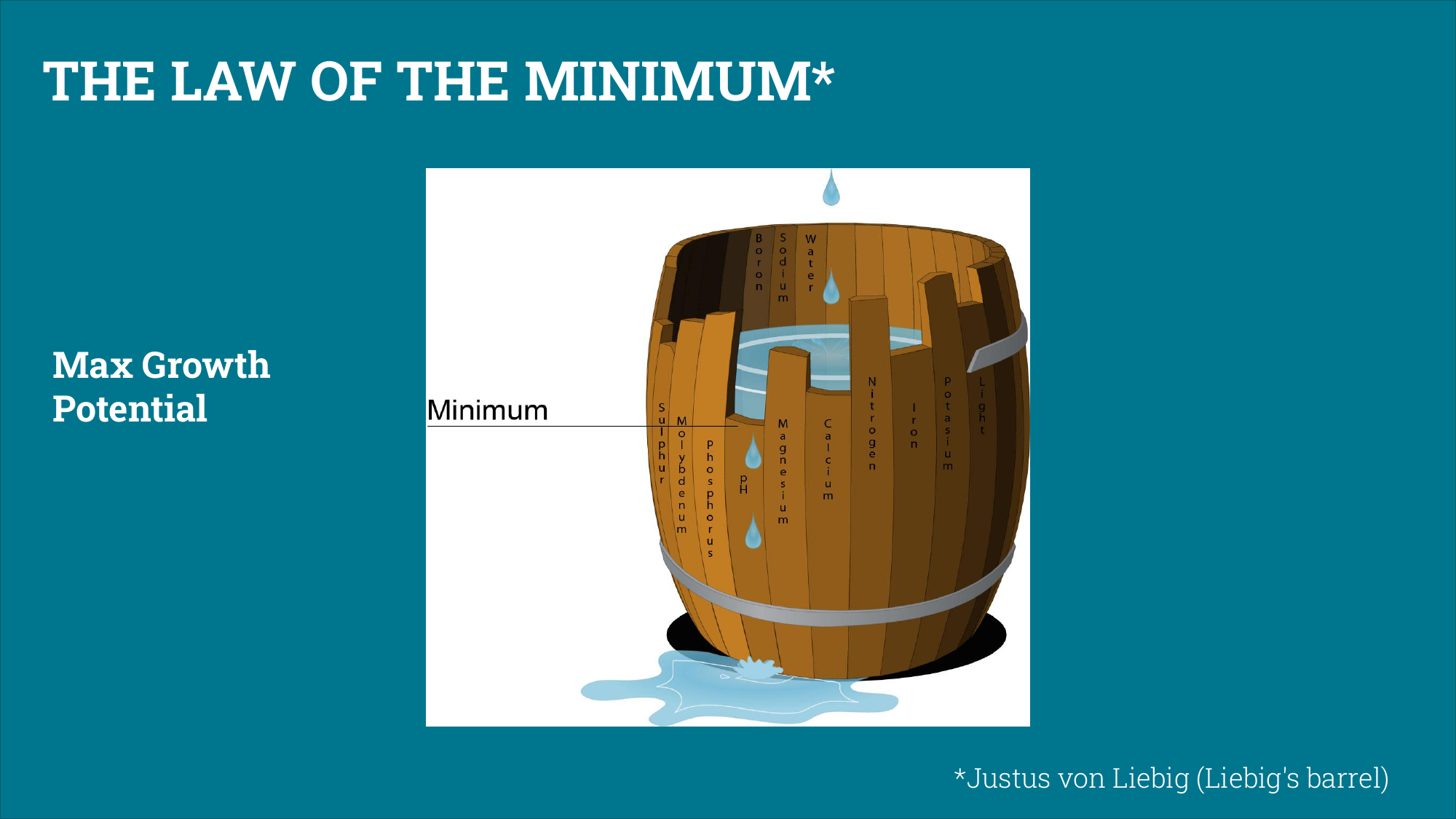
This brings us to the Justus von Liebig Law of the Minimum. This German scientist formulated this law that states if one of the essential components of plant nutrition is deficient, plant growth will be poor even when all other essential nutrients are abundant. He represented this law with a barrel, every important nutrient is represented by a different stave, ones are wider than others, but all of them need to reach the top of the barrel, if only one of them is short, you can only “fill” the barrel up to the level of the shorter one.
This law considers nutrients and also considers pH, water, sunlight, and other important players in plant growth. This law not only applies to plant growth potential, it’s been used to model ecosystems, biological populations of microorganisms, and a lot of other topics where balance is key to optimize maximum potential.
Slide 8
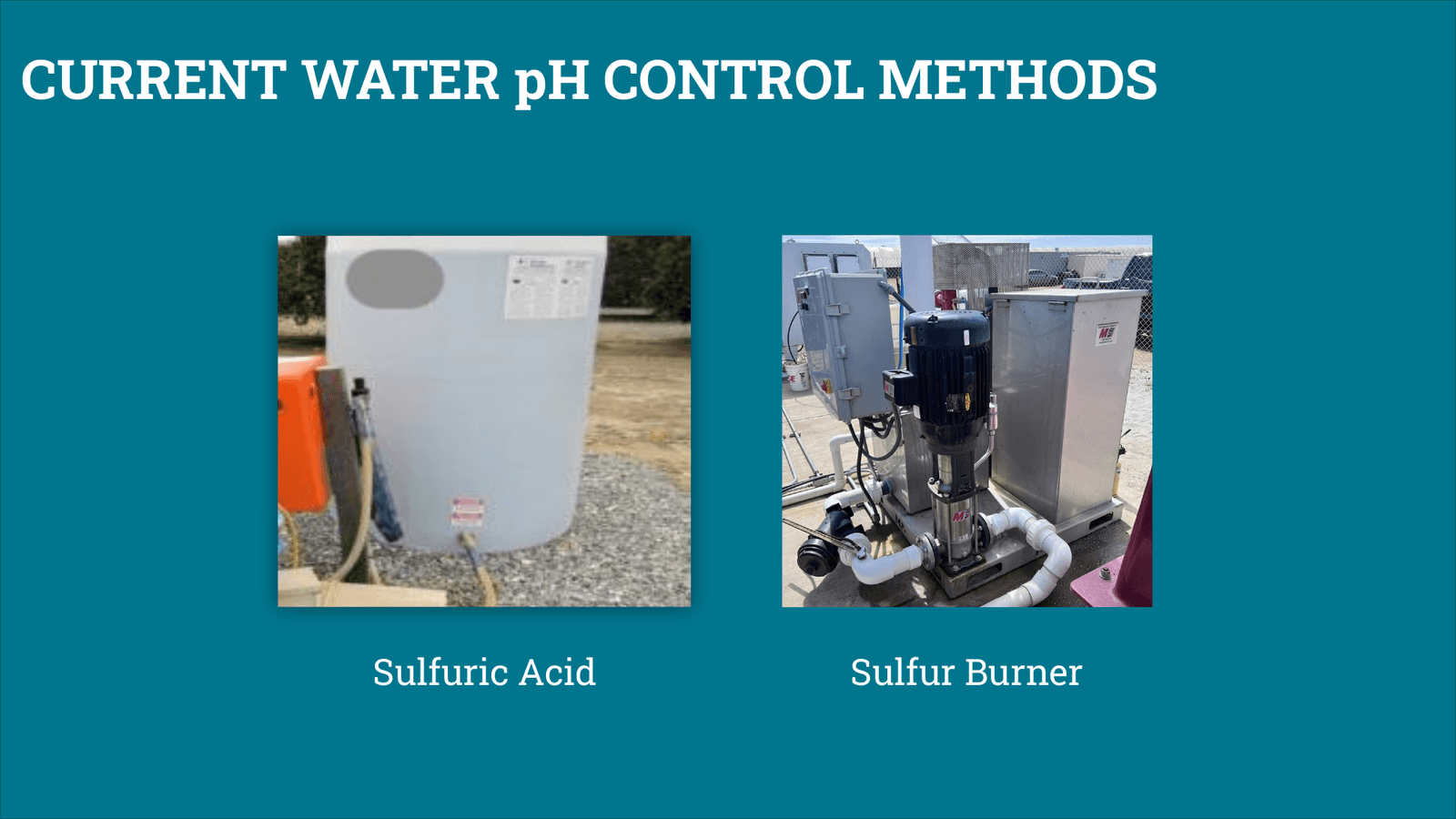
We have seen that water pH it’s important and needs to be adjusted, most of the time the water needs to be acidified, and the most common and widely used methods are either, the injection of liquid sulfuric acid directly into the irrigation mainlines, or to burn sulfur and mix that sulfur dioxide gas with water to make sulfurous acid, at the end of the day, they are both using sulfuric acid to adjust water pH.
I was personally involved in the design and installation of more than 200 systems that inject sulfuric acid, in Chile, Mexico, and other countries, almost all of those systems are not in service anymore, mostly because of bad soil health after a few seasons of applying sulfuric acid to the soil. The soil turned into dirt, poor microbial activity, or sometimes ZERO life in the soil. These 2 methods are still very popular and used in agriculture and turf management, but we believe that this is because not so many know that other options are available, or sulfuric acid is the cheapest one.
Slide 9
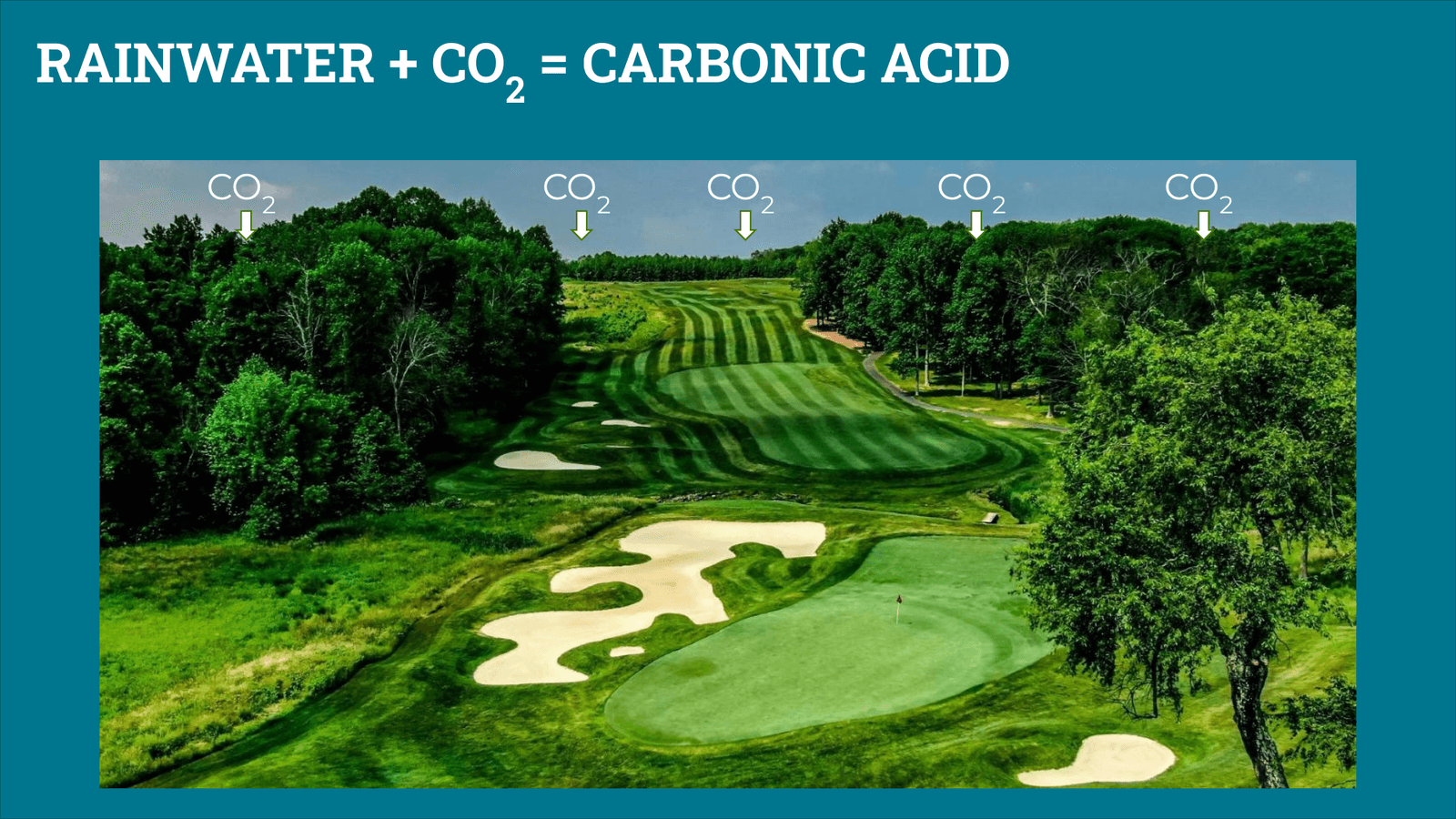
There’s another acid in nature that helps to reduce water pH more efficiently, this is not new, it occurs every time it rains and has been used to reduce water pH for more than 40 years in industries like wastewater treatment and the remineralization of the water after a reverse osmosis treatment, and little had been done in agriculture, but almost all of these Ag treatments have seen very good results.
Carbonic acid is made when carbon dioxide is fully dissolved in water, with a pH of around 5.5, carbonic acid reduces water pH in a more natural, safe, and efficient way, carbonic acid is the most common and natural water acidifier in nature.
Slide 10
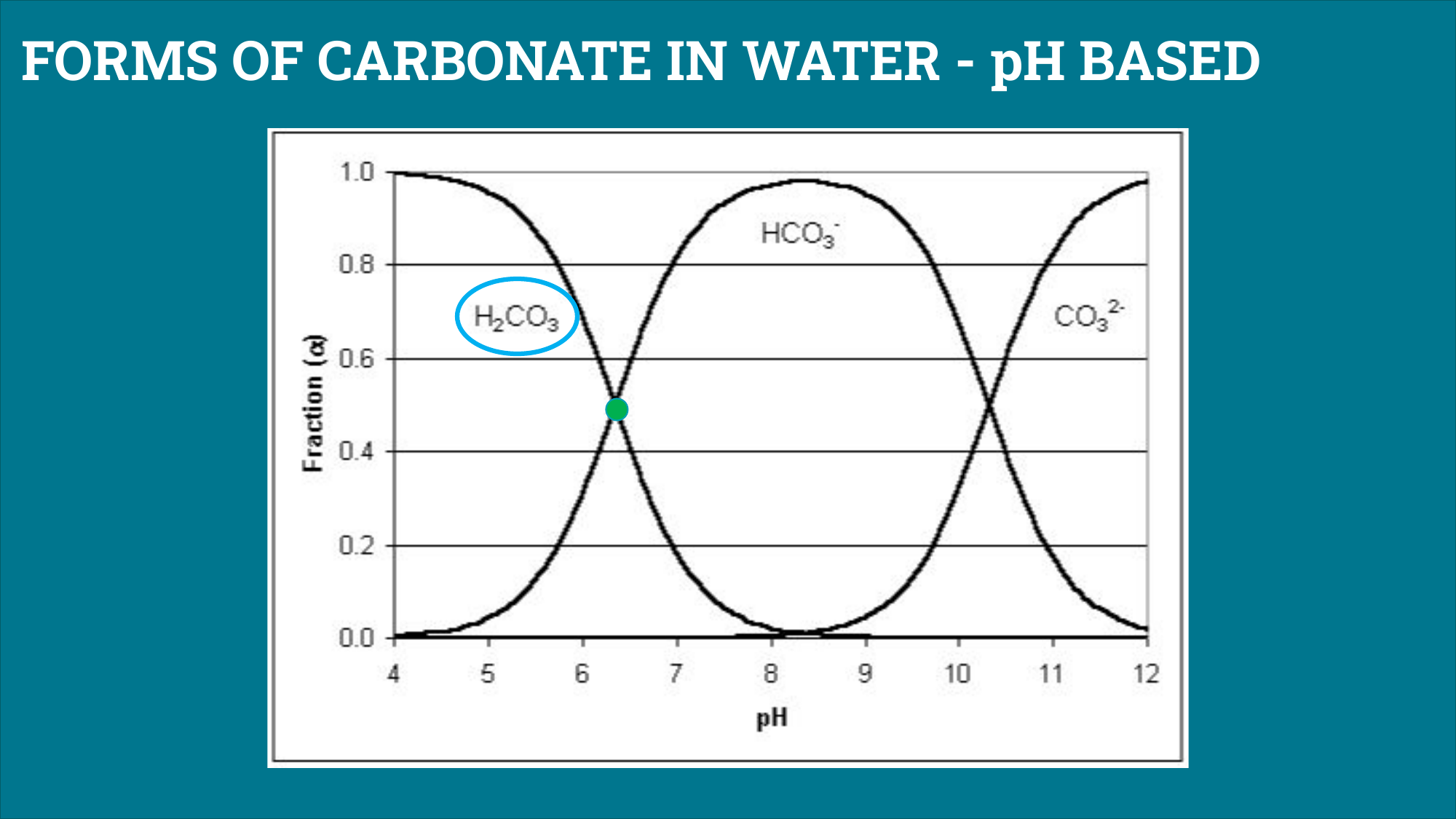
Carbonic acid is part of how forms of carbonates are present in water, when the pH is high, we have a combination of carbonates and bicarbonates, when the pH is around 8.5 we have 100% bicarbonates, and when the pH is around 6.5, we have 50% of bicarbonates and 50% of carbonic acid, for us, this is the sweet spot for water pH for irrigation, with a pH of 6.5 we have almost all the benefits of the carbonic acid, and some bicarbonates, totally necessary for nutrient uptake and soil interactions.
Poll — Were you previously aware of carbonic acid as a water pH control method?
- Yes, I’m familiar — 21%
- Heard of it, but not in detail — 17%
- No, this is new to me — 62%
Slide 11
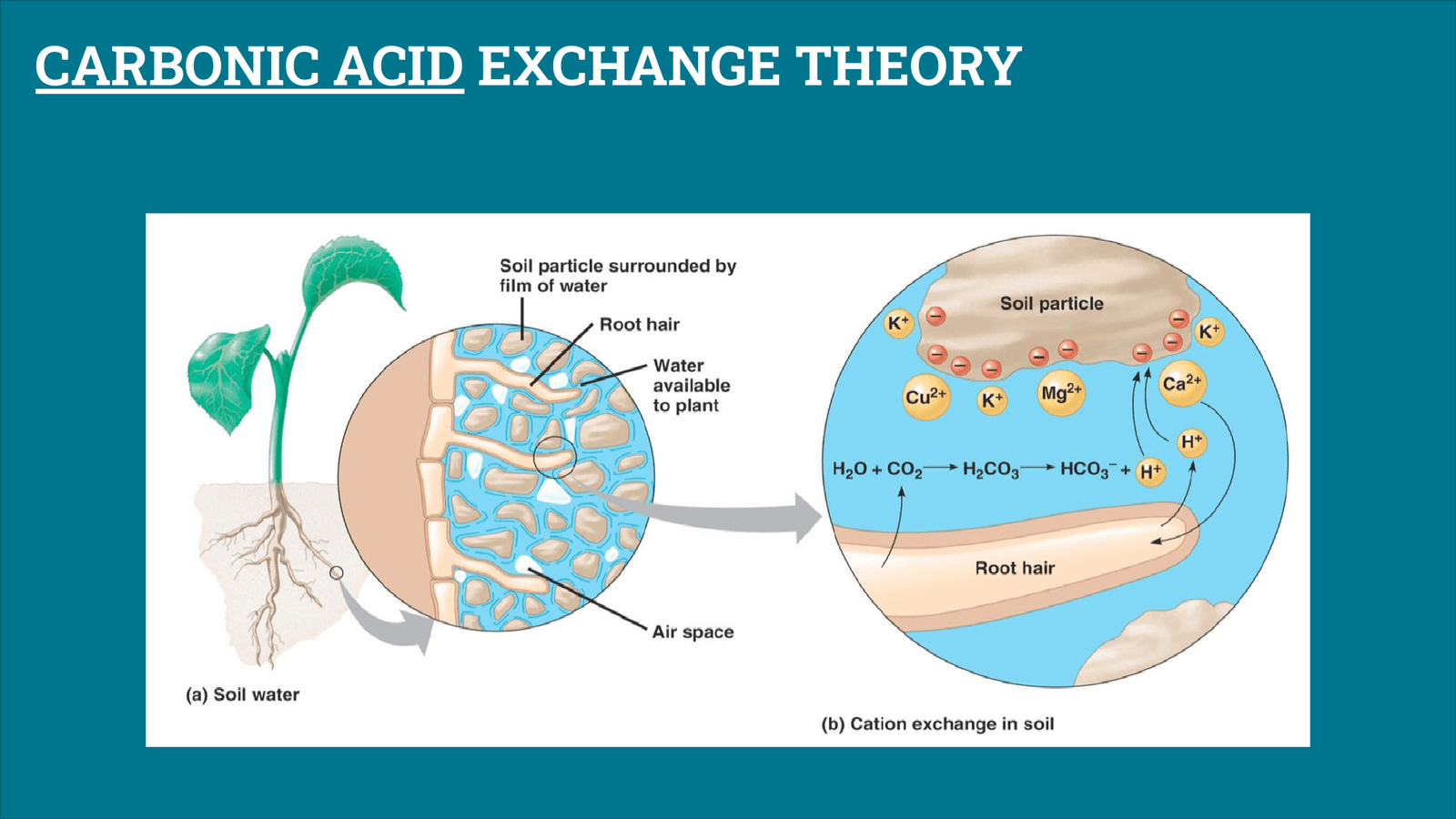
In this next slide, we can see that carbonic acid is in nature not only as rainwater, it’s also one of the methods that roots use to exchange nutrients with the soil particle. The plant releases carbon dioxide, through the root hairs, to make carbonic acid with the water present near the root zone, then that carbonic acid donates a proton to replace it with any cation present in the soil particle, and that new bicarbonate is later the one that’s going to transport the Calcium, Potassium, Copper or Magnesium to the plant. Here we can see that carbonic acid is key in the natural interaction between the plant and the nutritional solution near the root zone.
One important characteristic of carbonic acid is its stability in water, carbonic acid stays as an acid for longer periods of time, it’s not the same as bubble CO2 into the water. The undissolved bubbles of CO2 are more susceptible to gas-off from the water, making the process expensive, because of the excess of CO2 needed, and it’s not the best way to get all the benefits of the carbonic acid.
Slide 12
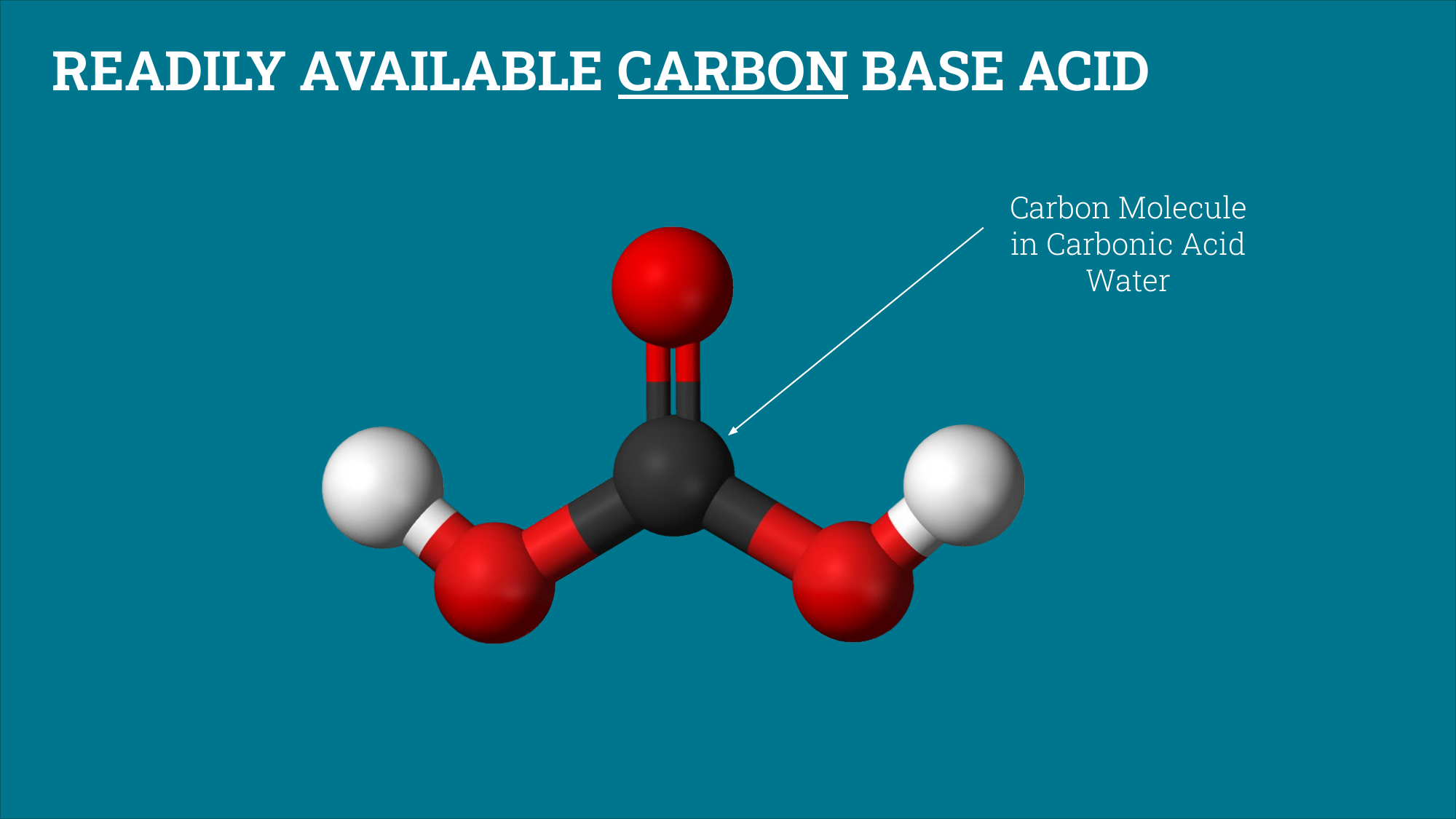
One other factor to consider when we study the carbonic acid alternative to adjust water pH is that it’s the only carbon-based acid in the market, there’s a carbon molecule in the carbonic acid. We have seen, this carbon is later sequestered into the soil. This means the carbon is trapped in the soil instead of being released into the atmosphere as it would be in other processes.
Slide 13
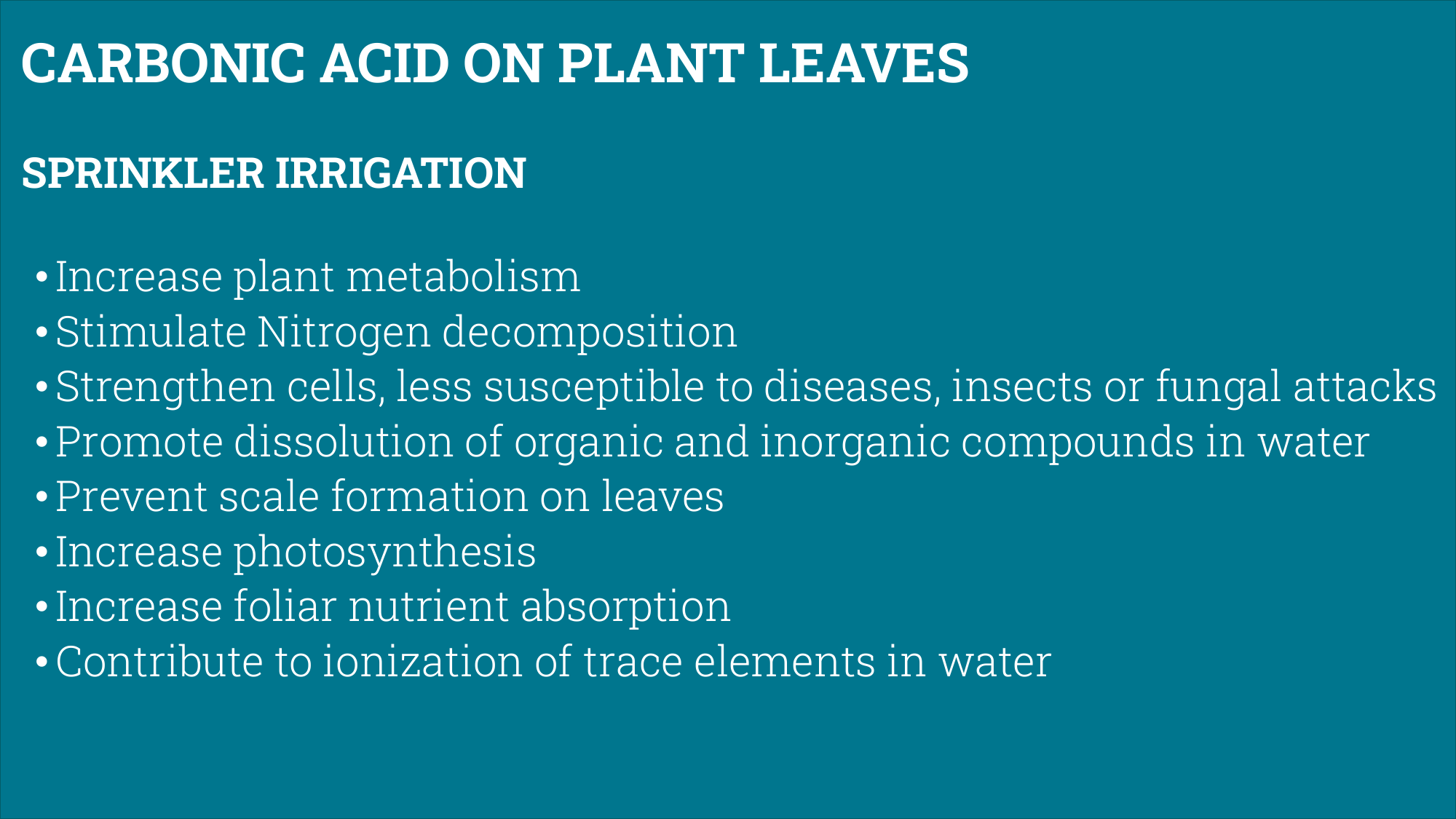
If we consider that on turf, the water is delivered to the plant using sprinklers reaching the plant leaves first, same as rainwater, and then goes into the soil and roots. This water with a high concentration of carbonic acid has a lot of benefits for the plant:
- The carbon dioxide comes straight through the plant leaves, improving photosynthesis
- Increase plant metabolism
- Prevent scale formation on leaves, no white residues
- Increase nutrient absorption through the leaves
- Contributes to ionization of trace elements in water
These benefits are more common in turf grass, we don’t have them when we use drip irrigation on trees or row crops. For this reason, turf grass gets more of the benefits when switching to a carbonic acid treatment.
Slide 14
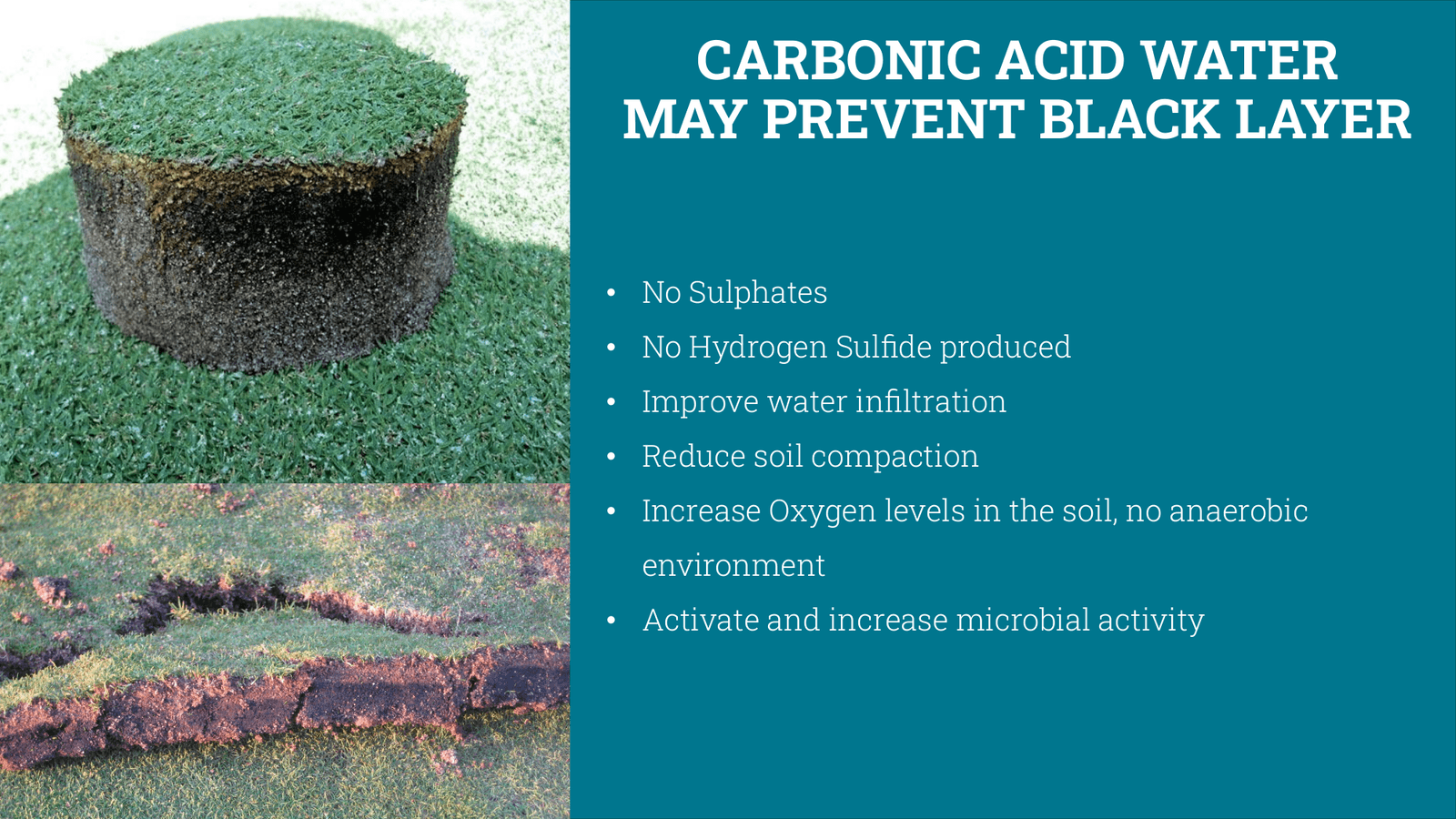
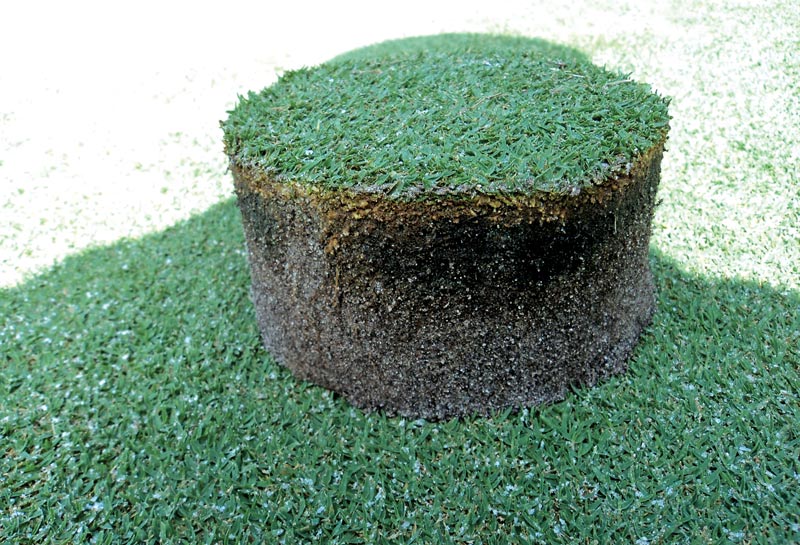
Carbonic acid MAY also help to prevent black layer in the soil, as we know, black layer is a problem that occurs when oxygen levels in the soil drop, there’s a decline in root growth, weak turf, and poor water infiltration. Using carbonic acid we may reduce the negative factors that lead to a black layer condition:
- There are NO sulfates involved, like when we use sulfuric acid or sulfur burners
- There is NO anaerobic environment, we have 3 molecules of oxygen in the carbonic acid, that helps to oxygenate the soil
- Carbonic acid IMPROVES water penetration, reducing soil compaction due to more glomalin produced at the root level, glomalin has been proven to aggregate the soil, according to USDA research from Sara Wright done in 2002, we have seen those results in the last years using carbonic acid treated water
- Activate and increase biological activity in the soil, more microbes, more nutrient uptake, more healthy turf, more natural cycle underground
All these characteristics may help to prevent the black layer in soils with low water mobility.
Slide 15
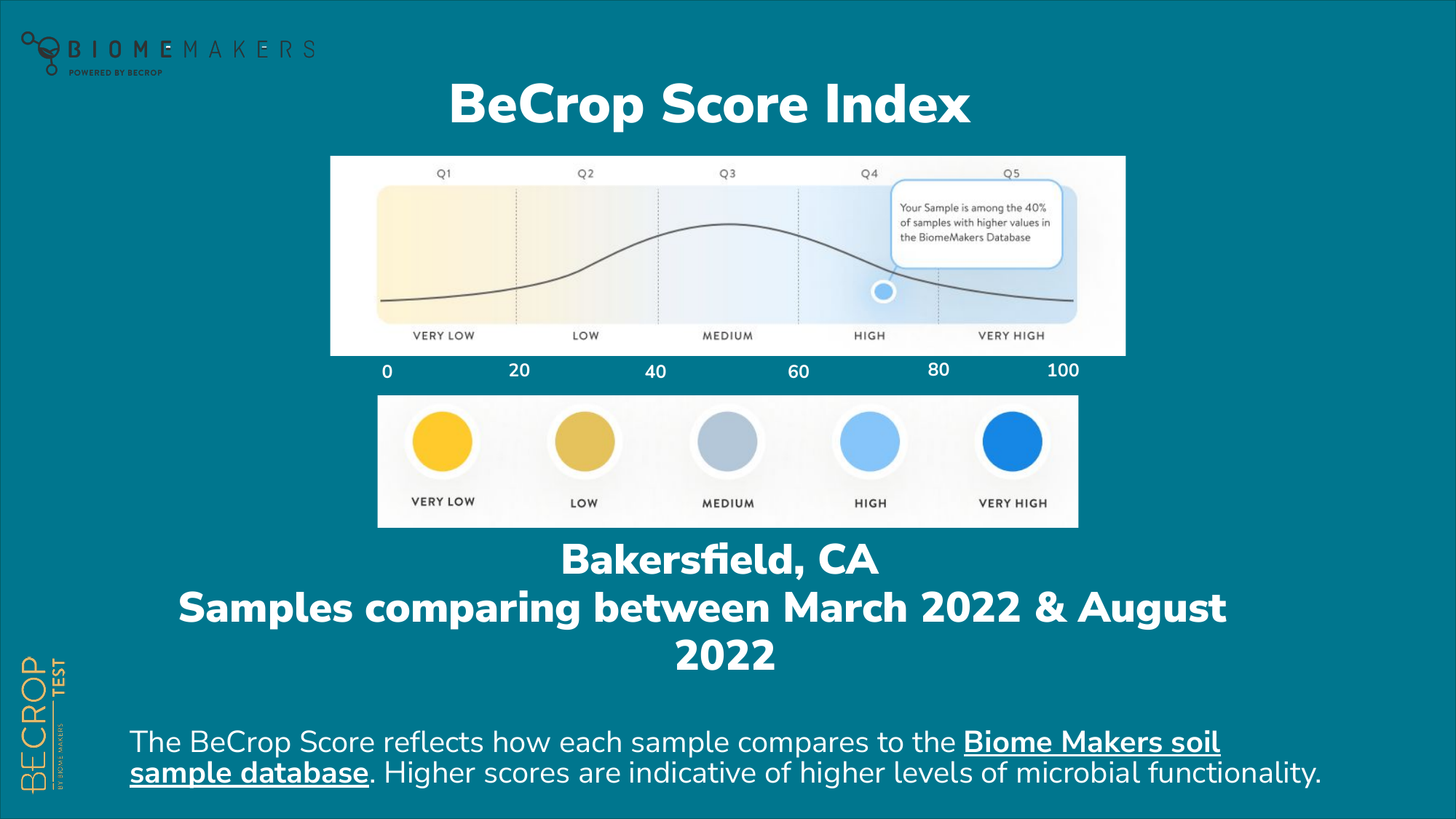
To understand better what changes in the soil, after switching to a carbonic acid system, I would like to share soil tests we have done using a very new method, this soil test is done by a partner company named Biomemakers. They have a special DNA sequence test named BeCrop, in this test they identify most of the soil microbes present in a sample, and compare them with a huge database they have. They group and identify different pathways for these microbes, all based on the microbial functionality, a high BECROP SCORES means that the microbes (bacteria, fungi, and others) present in the soil can help the plant on that particular pathway, these results are NOT like a typical soil test, it needs to be read carefully, we can help you on that if you like, just contact me via email after the webinar, happy to help.
Slide 16
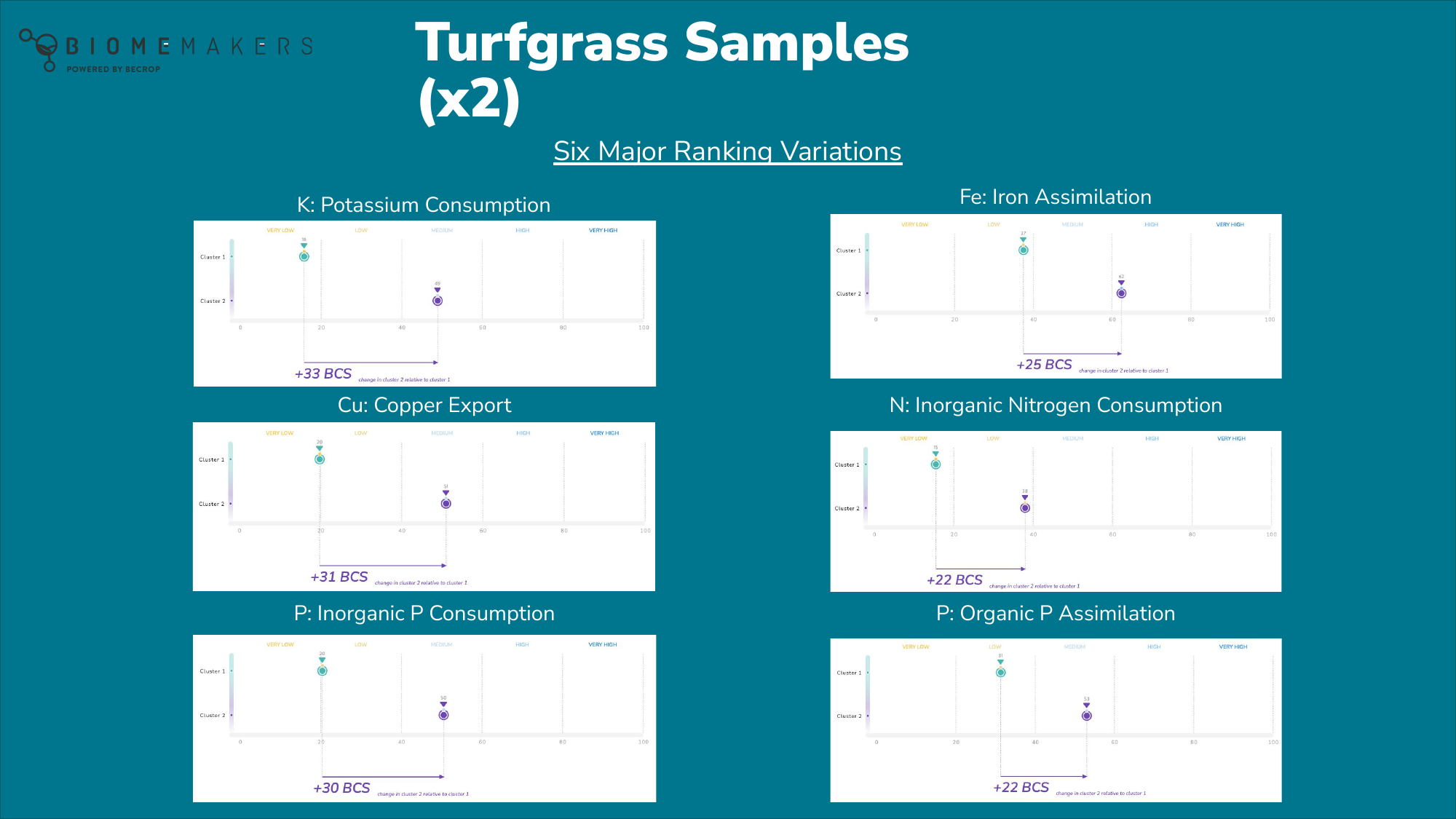
Here is an example, these samples were taken between March and August of 2022 at a golf course located in Bakersfield, CA, we identified 6 major ranking variations, like:
- Potassium Consumption
- Copper Export
- Inorganic Phosphorus Consumption
- Iron Assimilation
- Inorganic Nitrogen Consumption
- Organic Phosphorus assimilation
Each of these microbial pathways improves between 22 to 33 BeCrop Score, the scale they use is between 0 to 100. These are great improvements considering that the comparison was made with samples taken in March 2022 with samples taken in August 2022 at the same spots along the course.
Slide 17
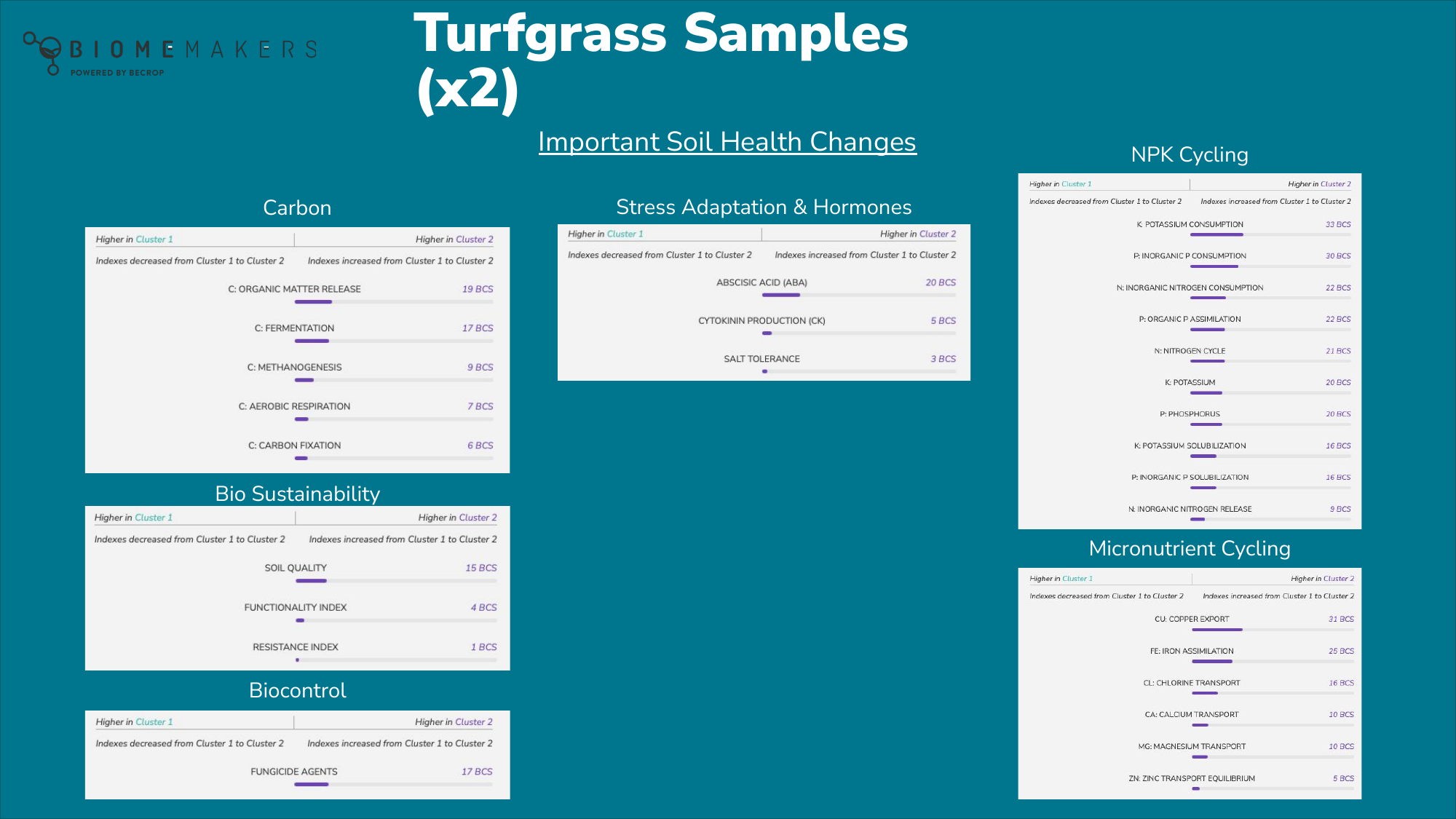
On this slide we show what are the most important changes in soil health on the same samples.
On the Carbon pathway, what we saw are several pathways that changed positively, like organic matter release and carbon fixation. Some of these changes can increase carbon content in the soil, and some of them may decrease the carbon content in the soil, but all of them show us a more active carbon cycle and by consequence more biological activity in the soil.
On the biosustainability & biocontrol pathway, we saw an improvement in the soil quality, functionality, and resistance index.
On the Stress Adaptation pathway, we can see more salt tolerance & Hormone production like Abscisic acid, and Cytokinin production. Here we can see that the microbes in the soil, that could help in plant hormone production changed, in a very positive way, the interaction between soil microbes and plants is very important, we don’t have to only look at chemical interactions, like we used to, we have to look at the soil as a complete new biosphere, and then decide a specific treatment or practice in our field, we need to always look to improve soil health.
On the NPK & Micronutrient Cycling pathways, we can see great improvements in almost all nutrient interactions between the soil and the plant.
Slide 18

This graph shows the changes in the organism’s uniqueness between both samples. The population of species did not change much in quantity, but changed a lot in uniqueness, switching from one type of species to a different one, following the different pathways we saw in the previous slides.
Slide 19

At last the comparison on this slide shows that the different types of bacteria, fungi, yeast, and others change, the AFTER sample is more diverse, look at the fungi “circles” (light blue) in the August sample, compared with the march one, all these different fungi are beneficial fungi, same with more bacterias, these also helps to a better fungi/bacteria ratio.
Analyzing these soil samples we can conclude that the use of carbonic acid seems to be going in the right direction, especially if we look to adopt more sustainable and safe methods to deal with our water quality.
Poll — Based on the soil health improvements shown, how likely are you to consider carbonic acid treatment?
- Very likely — 47%
- Somewhat likely — 37%
- Unsure — 16%
- Unlikely — 0%
Slide 20
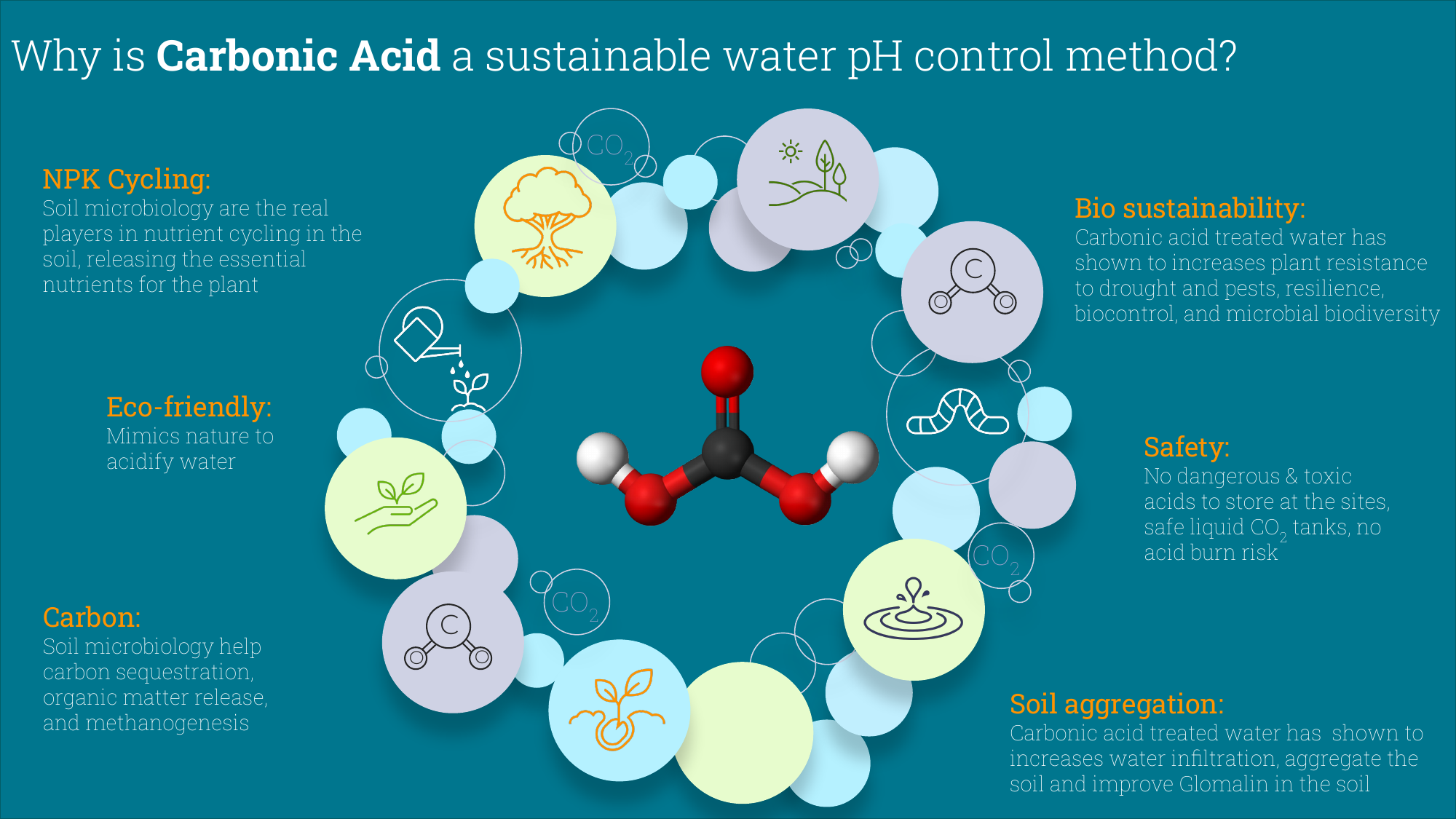
To highlight some of the benefits that we have seen after the use of carbonic acid-treated water we can say that:
- Mimics nature, we have rainwater and the carbon exchange theory
- Feed soil microbes with carbon
- It’s safe, something that we all are looking to include in our day-to-day practices
- NO corrosive chemicals, no hyper acidification, can not acidify soil in excess, like sulfuric
- Prevent scale formation and sprinkler clogging
- Increase NPK and micronutrient cycling
- Improves carbon in the soil, either to sequester it or as a food source for the microbial universe present in the soil
- Eco-friendly and sustainable
- It’s safe, for the people, operators, and the environment
- Improves plant & soil resistance and resilience, increasing the microbial biodiversity in the soil
- Improve soil aggregation, increasing water penetration and potentially eliminating water run-off
All these changes are going in a very positive direction.
Poll — Which benefit of carbonic acid treatment is most appealing to you?
- Improves soil health — 72%
- Eco-friendly and safe — 6%
- Enhances nutrient absorption — 6%
- Prevents soil issues like black layer — 6%
- Other — 11%
Slide 21

We kindly suggest that you consider your options. If you aren’t controlling your water pH, take a water sample, and talk to an agronomist, I hope you can understand the importance of the correct water pH. If you are controlling your pH, I encourage you to look at your options and consider switching to a carbonic acid system, it’s a proven solution.
Slide 22

Thank you very much for your time, and I hope to see you all at the GCSAA Conference in Phoenix in a couple of weeks. I am happy to share these slides if you are interested. Do you have any questions?

Was this article helpful?
Thanks for your feedback!

Better Water for Healthier Turf
Get a Proposal